Being Denied Entry to Thailand Is Like Being Denied Service at McDonald’s
Being denied entry to Thailand, in my opinion, is like being denied service at McDonald’s. It makes no sense. The bar to get into the country is non-existent. The business needs the customer, and yet here we are, watching nearly two hundred people a day get refused at the door of a country that has built its entire economy around those people showing up.
I can promise you that that is not a figure I’m inventing for dramatic effect. That is the official figure from Thailand’s own Immigration department. Twenty-nine thousand four hundred and ninety foreigners denied entry in the first five months of 2026 alone. Mostly there are not criminals, nor are they overstayers, they are not people on Interpol red notices. Many of these people are ordinary tourists with valid passports, valid tickets, hotel bookings, and in many cases years of clean travel history with Thailand, being turned away at the door. By a country whose economy, to a large extent, depends, more than any other country in Southeast Asia, on those people walking in.
The Comparison That Makes the Numbers Hit Hard
We need to make a comparison for these numbers to really hit hard. In the whole of 2025, the same Immigration department denied around two thousand nine hundred foreigners under its visa run enforcement measures for the whole year. In the first five months of 2026, it has denied entry to twenty-nine thousand four hundred and ninety across all categories. This is a brand new campaign, deliberately accelerated, against the very people the country sells itself to.
The deeper you go into this story, the more obvious it becomes that the country has stopped behaving like a tourism economy and started behaving like a country that has confused its own customers with its worst enemies.
The Official Line on the Three No’s Campaign
Let me start with the official line, because the official line is the first thing that gives the game away. The Immigration department calls the campaign the Three No’s. The branding is supposed to make it sound systematic, professional and somewhat targeted. The reality, when you read the actual criteria, is that the campaign is targeting visa-run patterns, undisclosed remote work, and watchlisted nationalities. That sounds defensible on the surface, until you realise that the way these criteria are being applied means that any foreigner who has visited Thailand more than twice in twelve months, any foreigner found to have any work app on their phone, and any foreigner from a country the Immigration department has decided to scrutinise more harshly that week, is potentially in the firing line. The criteria are wide. The enforcement is selective. The officer at the desk has total discretion. And the result is the figure you just heard. Two hundred a day. In a country whose tourism arrivals are already down by 4.2 per cent year on year.
What This Means for the Average Traveller
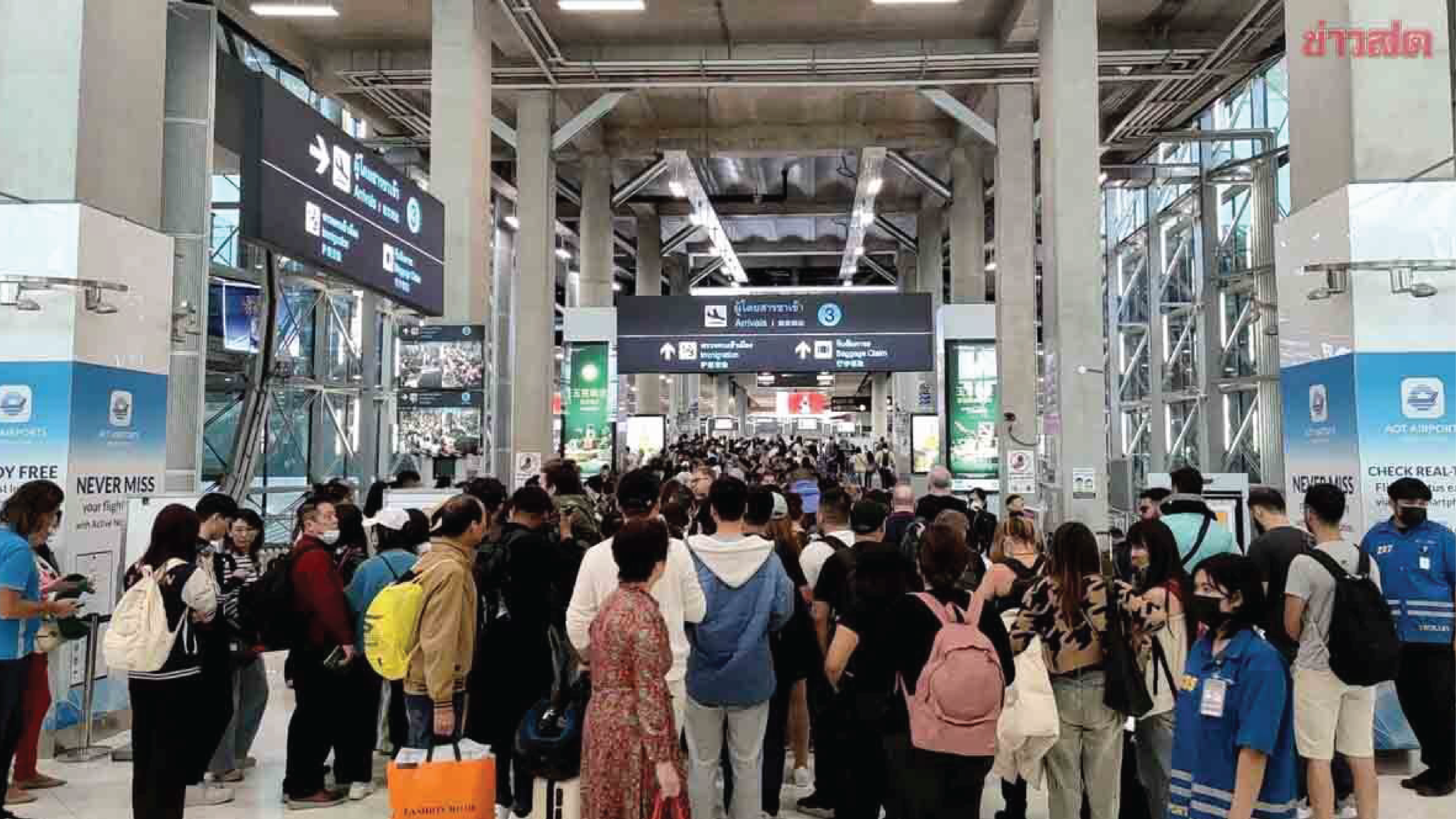
Think about what that means for the average traveller. You buy your ticket. You book your hotel. You complete the new and un-Thailand like Thailand Digital Arrival Card seventy-two hours before flying. You arrive at Suvarnabhumi airport or Don Mueang. You queue at immigration with everyone else, and then, when you get to the desk, the officer scrolls through your travel history, looks at your face, and decides, on his own discretion, that you have entered Thailand too many times this year, or that you are carrying too little cash. Maybe the apps on your phone suggest you might be working, or that your passport is from a country he was told to look at more carefully this morning. Then he sends you back, straight onto the next flight home, at your own expenses. Sometimes you have to suffer the indignity of a multiple hour wait in a holding room. You get no appeal, no second chance, and no explanation, beyond a vague reference to a rule that nobody told you about because the rule was never publicised in the first place.
The Don Mueang Case That Shows the Absurdity
Let me give you one documented case, because the case shows you exactly how absurd this has become.
In December 2025, a twenty-three-year-old female traveller arrived at Don Mueang Airport in Bangkok. She had been to Thailand multiple times before with no issues. She filled out the immigration paperwork, queued up, and presented herself at the desk. The officer denied her entry. The official reason given was insufficient funds. She did not have twenty thousand baht in cash on her. She had never been told she needed it. Nobody had ever asked her to prove she had it on previous trips. The rule existed, technically, but who has ever been asked for this, I haven’t, no one I know has, it had never been enforced before. She was held in the airport holding room for thirteen hours, watching other foreigners get denied entry for reasons that, in her words, were insane. She was eventually put on a flight back. A few days later, she flew to Bangkok again. This time, through Suvarnabhumi instead of Don Mueang. She was waved through with zero issues. Same person. Same passport. Same money. Same travel history. Different airport. Different officer and a very different outcome.
That story is not exceptional. It is the system. It is what the system produces, every day, against nearly two hundred people, in airports that are supposed to be the welcome mat of a tourism economy.
Why This Is Actually Happening
So why is this happening. The official answer from the Thai government is that the country is cracking down on visa abuse, on illegal long-term residence, on transnational crime, and on the scam compounds operating along the Burmese border. All of which are real problems. None of which are being addressed by turning away a twenty-three-year-old tourist at Don Mueang for not carrying enough cash. The official answer does not match the official figures. The campaign is not about catching the bad people. The campaign is about producing enforcement numbers that the political class can hold up to remove attention from more pressing matters. And the easiest way to produce enforcement numbers is to turn away the people who have already arrived, paid for their flight, completed their paperwork, and have nowhere to go.
The bad people, the ones the campaign claims to be targeting, are not all flying in through Suvarnabhumi with hotel bookings and Digital Arrival Cards. They are entering through Mae Sot at three in the morning under militia protection, getting boats across the Moei River into the scam compounds at KK Park, in operations the Thai state has been allowing for eight years. The Immigration department that cannot, or will not, address that actual flow, is the same Immigration department that is now turning away ordinary tourists at the airport.
The November 2025 Visa Rule Tightening
The timing here is not coincidental and you would be wrong to think otherwise. In November 2025, the Thai government formally tightened the visa-exempt entry rules, limiting foreigners to two visa-free entries per calendar year unless they could prove a valid reason for more. The rules were poorly publicised. The Thai Hotels Association publicly complained that the new rules were not being communicated to tourists before they flew. The Hotels Association president, in a statement to the Bangkok Post, said openly that the situation has people considering two possibilities about why these denials are happening. Either tourists are unknowingly violating rules that nobody told them about. Or some officials are exploiting the rules as a vehicle for extortion. The Thai Hotels Association said that. Not me. An industry body whose members are losing bookings because of this, saying publicly that the most charitable explanations are tourist ignorance and official extortion. That is the level of confidence the Thai tourism industry has in its own immigration system in 2026.
The May 2026 Cancellation of the 60-Day Visa-Free Scheme
And then, in May 2026, the Thai cabinet voted to formally cancel the 60-day visa-free scheme for more than ninety countries. Reverting them to their previous, shorter, more restrictive visa categories. This is the country that, at the start of 2024, was rolling out a 60-day visa-free programme as part of the post-pandemic tourism recovery. By May 2026, the same country has cancelled it for ninety-plus nations, while simultaneously denying entry to people from the countries still on the visa-free list. The marketing is going in one direction. The enforcement is going in the opposite direction. And somewhere between the two, the actual tourist is being squeezed.
The Tourism Numbers Bangkok Cannot Wave Away
Let me give you the numbers, because the numbers are the part the political class in Bangkok cannot wave away. Thailand had 32.9 million foreign visitors in 2025, a 7.23 per cent drop from 2024. The first two months of 2026 saw arrivals fall another 4.2 per cent. Chinese arrivals collapsed by 34 per cent in 2025 and have not recovered. Tourism is roughly 12 per cent of Thai GDP, supporting between six and eight million Thai jobs. There is no version of the Thai economy in 2026 that survives without foreign arrivals at scale. And the country has chosen, at this exact moment, to deny twenty-nine thousand of them at the airport.
How Thai Immigration Officers Are Searching Phones at the Border
Now think about what gets searched at the desk now, because this is the part that should worry every digital worker who has ever considered Thailand as a base. Immigration officers in 2026 are in some cases demanding to inspect travellers’ phones and laptops at the airport. They could be looking for Slack notifications. Microsoft Teams conversations. Active client emails. Calendar invites for work meetings. Recent invoices, and anything that, in the officer’s interpretation, suggests the traveller might be planning to work remotely while in Thailand on a tourist visa. If anything is found, the entry is refused under the Alien Working Act. This is not a hypothetical. This is documented in Thai legal commentary published in March 2026. It is happening, in real time, to people who flew to Thailand for a holiday and now find an immigration officer scrolling through their personal phone at the desk.
And the absurdity of this should not need explaining. Digital nomads have spent billions of dollars in Chiang Mai cafés over the last fifteen years. Co-working spaces have been built across the country specifically to serve them. The Thai government, until recently, was actively marketing the country as a digital nomad destination. The Long Term Resident visa programme was created specifically to attract remote workers. And now the same country is turning back tourists at the airport for having Slack on their phone.
The Deeper Problem With How Thailand Is Being Run
Let me name the deeper problem. Thailand is not a country being run by a coherent national strategy. Thailand is a country being run by a political class that is at war with itself, against a backdrop of economic decline, corruption cases, household debt, a stock market scandal, a scam compound diplomatic crisis, and a Cambodia border conflict the country itself manufactured. The Immigration department has been given political authority to demonstrate visible enforcement, against a target the political class has decided is safe to enforce against. The foreigner.
You Are Not the Target. You Are the Demonstration.
You are not the target. You are the demonstration. The Immigration department is not turning you away because you are dangerous. It is turning you away because turning you away produces a number that the political class can put on a press release. The number on the press release demonstrates that the administration is tough on foreigners. The toughness on foreigners gives the political class something visible to point at while the household debt grows, the corruption cases get buried, and the property market sits empty. You are not the problem the campaign is solving. You are the raw material it is processing.
How the Calculation Has Changed for the Traveller in 2026
And the consequence for you, if you are reading this from outside Thailand and thinking about whether to fly, is that the calculation has changed. The Thailand of 2010, of 2015, of 2020, was a country where you arrived, queued, got stamped in, and started your holiday. The Thailand of 2026 is a country where the queue is shorter than it used to be because the country is turning people away at the front of it. Where the officer at the desk has total discretion. Where the rules are not consistently publicised. Where the same paperwork that worked at one airport can fail at another. Where your phone may be searched. Where insufficient cash on your person can be the reason your holiday ends in an airport holding room. Where the policy is being run by an institution that has every incentive to keep the figures climbing, because the figures are the point.
What to Do Differently If You Are Flying to Thailand in 2026
If you are flying to Thailand in 2026, you should be doing several things differently from what worked five years ago. You should be carrying at least twenty thousand baht in cash, or its equivalent in dollars or pounds, visibly accessible at the immigration desk. You should not be relying on a credit card balance to satisfy the funds requirement. You should not have more than two visa-free entries in your passport for the calendar year, or you should be ready to explain why with documentation. You should clean your phone of any work-related apps or notifications that an officer might find when scrolling through it. You should have a printed itinerary, a printed hotel booking, and a printed return ticket and you should be ready to be questioned for longer than you ever have before.
None of which is the relationship a country supposedly running a 12 per cent of GDP tourism economy should have with the people funding that 12 per cent. This is not how welcoming countries treat their welcomed guests. This is how a state apparatus that has confused its mission treats the people it was supposed to serve.
Thailand Has Decided to Treat Its Own Customers as a Threat
Being denied entry to Thailand should be like being denied service at McDonald’s. The bar is supposed to be on the floor. The business is supposed to need the customer. The whole thing is supposed to work because anyone who turns up and has the basic paperwork gets in. That is not a low standard. That is the standard every tourism economy in the world runs on, because every tourism economy in the world understands that the customer is the asset, not the threat.
Thailand has decided otherwise. Thailand has decided to treat its own customers as a threat. Twenty-nine thousand four hundred and ninety in five months. Nearly two hundred a day. In a country whose tourism arrivals are already falling, whose economy is already weakening, whose regional alternatives in Vietnam, Cambodia, and Indonesia are already taking the visitors Thailand is losing.
Thailand Is Not Running a Tourism Economy. It Is Running a Bouncer’s Revenge.
The bouncer at the front door of the McDonald’s has decided he is the most important person in the building. He is not. The customers are. And every customer he turns away is a customer who will go and eat somewhere else, and never come back, and tell their friends not to come either.
Thailand is not running a tourism economy any more. Thailand is running a bouncer’s revenge. And the people paying the price are the foreigners who thought they were customers, and the Thai population whose jobs depend on those customers, and the country itself, which is busy demonstrating to the world that it has forgotten what it is for.
Frequently Asked Questions
How many foreigners have been denied entry to Thailand in 2026?
Twenty-nine thousand four hundred and ninety foreigners were denied entry to Thailand in the first five months of 2026 alone, according to Thailand’s own Immigration department. That works out to nearly two hundred denials per day. The figure represents a dramatic acceleration from the previous year, when approximately 2,900 foreigners were denied entry under the visa-run enforcement measures rolled out in early 2025.
What is Thailand’s Three No’s campaign?
The Three No’s is the name Thailand’s Immigration department has given to its current enforcement campaign targeting foreigners at the border. The criteria, as publicly stated, focus on visa-run patterns, undisclosed remote work, and watchlisted nationalities. In practice, the criteria are wide, the enforcement is selective, and the officer at the desk has total discretion. The result is that ordinary tourists with valid passports, hotel bookings, and clean travel histories are being turned away in volume.
Why was a 23-year-old denied entry at Don Mueang Airport?
In December 2025, a 23-year-old female traveller arrived at Don Mueang Airport in Bangkok after previous successful entries to Thailand. The Immigration officer denied her entry under the “insufficient funds” rule, which technically requires foreigners to carry 20,000 baht in cash but had not previously been enforced. She was held in the airport for thirteen hours and put on a return flight. A few days later, she flew into Suvarnabhumi instead and was waved through with zero issues. Same person, same passport, same money, different airport, different officer, completely different outcome.
What is the cash requirement for entering Thailand?
Foreigners entering Thailand should be carrying at least 20,000 baht in cash, or its equivalent in dollars or pounds, visibly accessible at the immigration desk. The rule existed in Thai law for years but was not enforced. In 2026 the Immigration department has begun enforcing it at the border. Credit card balances are not accepted as proof of funds. Cash is required.
Are Thai immigration officers really searching phones and laptops?
Yes, in some cases. Documented in Thai legal commentary published in March 2026, Immigration officers in 2026 are demanding to inspect travellers’ phones and laptops at the airport, looking for Slack notifications, Microsoft Teams conversations, active client emails, calendar invites for work meetings, and recent invoices. Anything that suggests the traveller might be planning to work remotely on a tourist visa can result in entry being refused under the Alien Working Act.
Why is Thailand doing this when tourism is 12% of GDP?
Because the political class running Thailand has decided that visible enforcement against foreigners is electorally rewarding and carries no domestic political cost. Foreigners cannot vote, cannot organise, cannot complain in Thai media, and do not appear in polling numbers. The Immigration department has been given political authority to demonstrate enforcement vigour, against a target the political class has decided is safe to enforce against. The 29,490 denial figure is the political product. The tourism economy is the collateral damage.
What should I do differently if flying to Thailand in 2026?
Carry at least 20,000 baht in cash visibly accessible at the immigration desk. Do not rely on credit card balances. Do not have more than two visa-free entries in your passport for the calendar year, or be ready to explain why with documentation. Clean your phone of work-related apps and notifications that an officer might find when scrolling through it. Have a printed itinerary, printed hotel booking, and printed return ticket. Be ready to be questioned for longer than you ever have before. Enter through Suvarnabhumi rather than Don Mueang where possible, because the discretion gap between airports is real.
Sources
- Thai Examiner — Bureau of Immigration announcement on the Three No’s enforcement campaign, the official figure of 29,490 foreigners denied entry in the first five months of 2026 under the visa-run pattern enforcement, watchlisted nationalities, and undisclosed remote work criteria, the headline number that drives the entire article
https://www.thaiexaminer.com/thai-news-foreigners/2026/05/22/thailand-tightens-immigration-controls-thousands-of-foreigners-denied-entry/ - Lexology — New Thailand Visa Exemption Crackdown Explained, November 2025 legal analysis confirming that approximately 2,900 foreigners had been refused entry under the early-2025 visa-run pattern enforcement measures, the baseline comparison figure against which the dramatic 2026 acceleration is measured
https://www.lexology.com/library/detail.aspx?g=a529a256-c857-4905-9509-ac591ec979b1 - Bangkok Post — Thai Hotels Association statement on rising tourist entry denials, the industry body’s public complaint that the new immigration rules are not being properly communicated to travellers before they fly, with the Hotels Association president stating openly that the situation has people considering two possibilities: tourists unknowingly violating rules nobody told them about, or officials exploiting the rules as a vehicle for extortion
https://www.bangkokpost.com/business/tourism-and-transport/ - Royal Thai Government Cabinet Resolution — May 2026 cancellation of the 60-day visa-free scheme for more than 90 countries, the official decision reverting visa-free entry from 60 days back to the shorter previous categories, with effect across the affected nationalities, the formal policy shift that demonstrates the contradiction between marketing and enforcement
https://www.thaigov.go.th/news/contents/index/cabinet - Tourism Authority of Thailand — Official Tourism Statistics for 2025, the figure of 32.9 million foreign visitors representing a 7.23 per cent year-on-year drop from 2024, the data the article uses to demonstrate that tourism is already contracting at the same time the Immigration department is accelerating denials
https://www.tat.or.th/en/statistics - Ministry of Tourism and Sports of Thailand — Foreign Tourist Arrival Reports for 2026, monthly arrival figures showing the 4.2 per cent year-on-year drop in the first two months of 2026 and the 34 per cent collapse in Chinese arrivals in 2025, the contextual data confirming that the country can least afford the enforcement campaign at this exact moment
https://www.mots.go.th/news/category/411 - The Thaiger — Thailand Immigration Phone and Laptop Searches at the Border, March 2026 reporting documenting that Immigration officers are inspecting traveller devices at airports for Slack notifications, Microsoft Teams conversations, active client emails, calendar invites for work meetings, and recent invoices, with entry refused under the Alien Working Act if anything is found
https://thethaiger.com/news/national/thailand-cracks-down-on-foreigners-working-remotely-on-tourist-visas - Alien Working Act B.E. 2551 (2008) — The Thai statute under which Immigration officers are refusing entry to foreigners found to have work-related applications on their phones, the legal mechanism used to deny digital workers at the border even when they hold valid tourist documentation
https://www.ilo.org/dyn/natlex/docs/ELECTRONIC/79336/85307/F1408876743/THA79336.pdf - Bureau of Immigration Thailand — Official policy announcement on the visa-exempt entry limit of two visa-free entries per calendar year from November 2025, the formal policy that the Immigration department is now using to deny re-entry to foreigners who have visited Thailand more than twice in a twelve-month period
https://immigration.go.th/en/ - Bank of Thailand — Tourism Contribution to GDP figures, official central bank data confirming that tourism accounts for approximately 12 per cent of Thai GDP and supports between six and eight million Thai jobs, the macroeconomic context that makes the enforcement campaign structurally incoherent with the country’s own stated economic priorities
https://www.bot.or.th/en/research-and-publications/articles-and-publications/articles.html