The Air In Chiang Mai Right Now
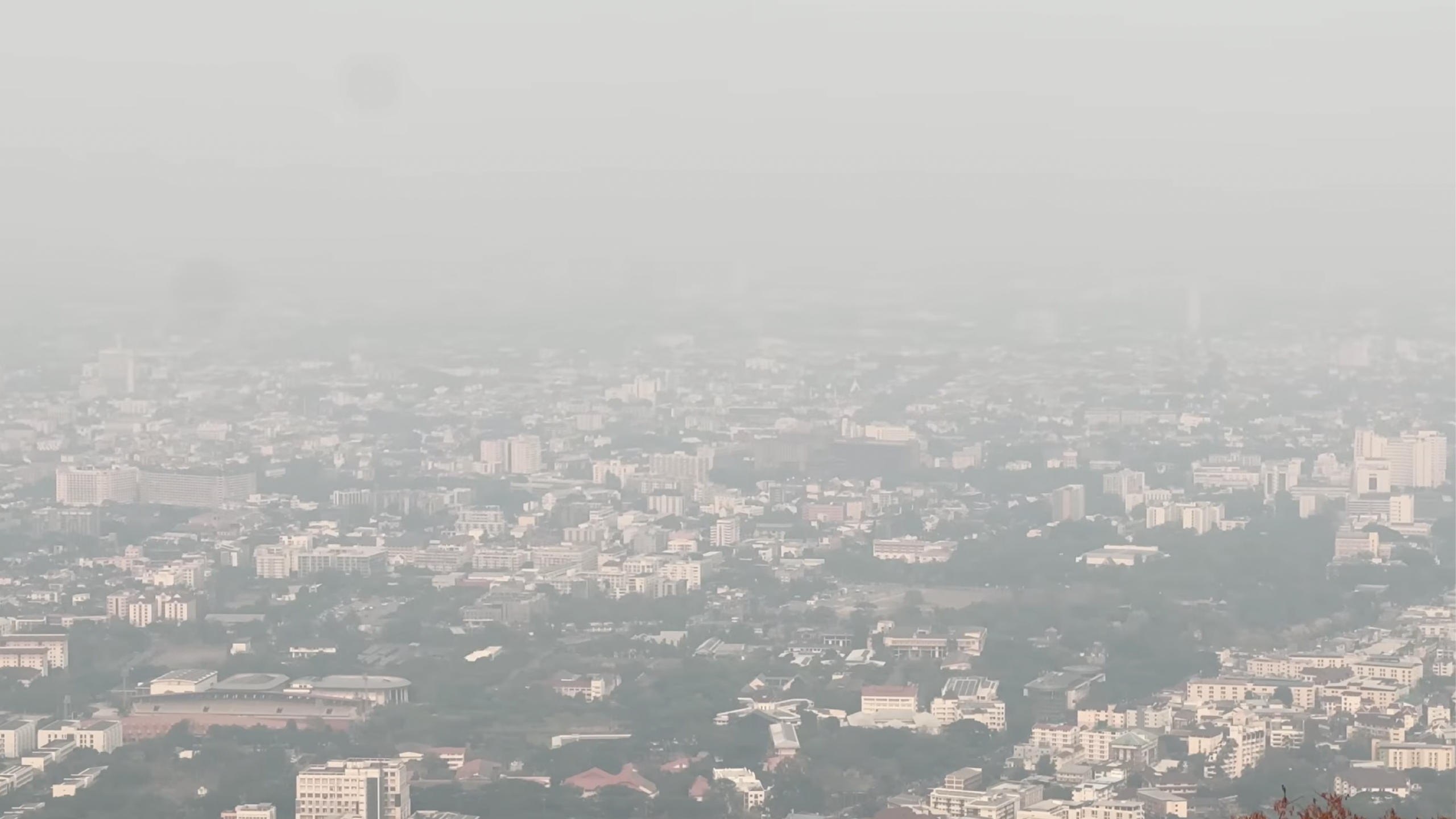
I live in Chiang Mai. Yesterday, the air quality index in this city hit 351. That is classified as hazardous, the worst category there is. Yesterday, PM2.5 hit 188 micrograms per cubic metre. The World Health Organization’s annual guideline is 5. Even its 24-hour guideline is 15. Either way, 188 is not bad air. It is toxic air. Right now, as I am writing this, the AQI is still above 300.
And every year it happens again. February through April. The sky turns grey. The mountains disappear. People wear masks not because of a virus but because the air is poisonous. Schools close. Hotels in Chiang Mai drop their rates by thirty percent because tourists won’t come. And then the rains arrive, the air clears, everyone goes back to normal, and nothing changes. Until the next year. When it happens again.
You already know the causes. Agricultural burning. Forest fires. Transboundary haze from Burma and Laos. Chiang Mai sitting in a basin that traps everything. This isn’t new information. Every site covering Thailand has done the burning piece. I’m not going to do the burning piece. I’m going to follow the money. Because when you look at where Thailand actually puts its budget, the air quality crisis starts looking like something other than bad luck.
The Pollution Control Department Budget Versus Everything Else
The Pollution Control Department of Thailand, the government body responsible for managing all pollution in the country, air, water, waste, everything, had a total budget in 2023 of approximately one point seven five billion baht. That is the entire budget. For all pollution. Nationwide. For the year.
Let me put that number next to some other numbers.
Thailand’s defence budget for fiscal year 2024 was one hundred and ninety-eight point three billion baht. That is one hundred and thirteen times the pollution control budget. On top of that, the military received six hundred and sixty million baht in secret off-budget funding, money with no transparency, no public accounting, and no oversight. A policy think tank noted directly that given the history of such funds, the lack of transparency could facilitate malfeasance. The secret military funds alone represent more than a third of what the Pollution Control Department gets for the entire year.
The Ministry of Tourism and Sports spent five point six billion baht in 2024. More than three times the pollution control budget. In 2025, when tourist numbers dipped slightly, the government proposed a three point five billion baht emergency stimulus package for tourism. That single emergency injection was double the entire annual pollution control budget. And a domestic tourism subsidy called Half-Half Thai Travel was announced with an initial budget of no less than twenty billion baht. Twenty billion. For hotel discounts. That is more than eleven times what the government spends on controlling the air its citizens breathe.
Meanwhile, the Cabinet approved eight billion baht to subsidize sugarcane farmers who don’t burn their crop. Eight billion. Four and a half times the entire Pollution Control Department budget. Not spent on equipment. Not spent on enforcement. Not spent on infrastructure. Spent paying people to not cause the problem. The government will pay farmers to stop making the air poisonous rather than fund the department whose job it is to stop them.
The Crisis Response That Came After The Crisis
In January 2025, Bangkok hit crisis-level pollution. PM2.5 reached a hundred and eight micrograms per cubic metre. Bangkok was ranked the fourth most polluted city on earth. The government’s response was to make public transport free for one week, at a cost of a hundred and forty million baht. Environmental experts said the money would have been better spent on air purifiers. A hundred and forty million baht on bus rides. For seven days. The department whose job is to prevent the crisis gets one point seven five billion for the entire year. The emergency response consumed eight percent of the annual prevention budget. In one week.
But notice what happened. The crisis arrived. And suddenly the government could move fast. Money appeared. Decisions were made. Press conferences were held. The Prime Minister flew back from Davos. Cloud seeding was ordered. Work from home schemes were announced. When the air became a political problem, the state could act.
The question is why it only acts after the damage is done. And the answer is in what each response looks like from the inside.
Why Prevention Generates No Contracts
Free bus rides means compensating transport operators. That’s a contract. Work from home schemes generate press coverage. Emergency stimulus packages create procurement. When the crisis is already here, the response generates contracts, visibility, and political credit. There are things to buy. People to pay. Ribbons to cut. Credit to claim.
Prevention generates none of that. Telling farmers to stop burning is not a contract. Monitoring air quality is not a photo opportunity. Enforcing regulations against powerful agricultural interests is not politically rewarding. Nobody in the chain gets a cut because there is no chain. Prevention is invisible. It has no vendor. No supplier. No middleman. No margin. And no politician has ever won an election by pointing at air that didn’t get dirty.
Where The Money Actually Goes In Thailand
So the money goes where it always goes. Into things that are visible, contractable, and politically useful. The defence budget buys submarines and fighter jets, a hundred and ninety-eight billion baht in procurement, plus six hundred and sixty million in secret funds that nobody has to explain. Tourism gets twenty billion in hotel subsidies, three and a half billion in emergency stimulus, hundreds of millions in festival budgets. Songkran alone generated a hundred and forty billion baht in economic activity, in April, the exact month Chiang Mai suffocates. The tourism machine runs at full speed during the weeks when the north of the country can barely see across the street.
Thirty-Two Thousand Thais Die Every Year
And here’s where the numbers become something worse than embarrassing. Thirty-two thousand people die from air pollution in this country every year. Ten million seek medical treatment. PM2.5 particles pass through your lungs and into your bloodstream. Long-term exposure causes respiratory disease, cardiovascular disease, stroke, lung cancer. Bangkok alone could prevent nearly fourteen hundred premature deaths a year by meeting Thailand’s own air quality standard. Not the WHO standard. Thailand’s. Which is already more than double what the WHO recommends.
The healthcare cost of treating ten million pollution-related cases almost certainly dwarfs the prevention budget many times over. But prevention doesn’t generate contracts. Treatment does. Hospitals, pharmaceutical supply chains, medical equipment, those are industries with procurement, suppliers, and margins. Prevention is a line item that saves lives but generates no revenue for anyone. Treatment is a market.
I am not claiming anyone sat in a room and decided to let people get sick. I am saying the system is built so that solving this problem is one of the least financially rewarding things the government can do. And the result is exactly what you would expect.
The Real Payoff Of The Thai Air Pollution Crisis
A Clean Air Act was approved in principle in late 2023. It still hasn’t been fully enacted. But in the time since, the government found eight billion baht to pay farmers not to burn. Twenty billion for hotel discounts. Three and a half billion for tourism stimulus. A hundred and ninety-eight billion for defence. Six hundred and sixty million in secret funds nobody has to explain. And a hundred and forty million for a week of free bus rides once the air was already poisonous.
The Pollution Control Department got one point seven five billion. For the year. For the country. For the air that thirty-two thousand people die breathing.
What Watching The Cycle From Chiang Mai Actually Shows You
I have watched this cycle from my home in Chiang Mai for years. The sky goes grey. People get sick. The government makes announcements. Then the rain comes. The air clears. And the money goes back to where it was always going. Into things that can be bought, sold, contracted, photographed, and claimed. Not into the thing that would save the most lives but offers the least opportunity for anyone in power to benefit from solving it.
That is not a failure of resources. Thailand has the money. That is not a failure of knowledge. Thailand knows exactly what is killing its people. That is a system working exactly as its incentives dictate. The farmers, the fires, the haze from Burma, those are the triggers. They are not the reason this keeps happening year after year. The reason is that clean air is one of the only national crises in Thailand where almost nobody in a position of power can make money from solving it. The reason is that saving thirty-two thousand lives a year generates no contracts, no procurement, no room for anyone in the chain to benefit, no ribbon cuttings, and no political credit. And so the air stays exactly as it is.
Thirty-two thousand a year. And counting.
Frequently Asked Questions
How bad is air pollution in Chiang Mai?
Yesterday the air quality index in Chiang Mai hit 351, classified as hazardous, the worst category there is. PM2.5 reached 188 micrograms per cubic metre. The World Health Organization’s annual guideline is 5 and its 24-hour guideline is 15. The actual reading was more than 12 times the 24-hour guideline. The pattern repeats every year from February through April, when agricultural burning combines with forest fires, transboundary haze from Burma and Laos, and the topography of the Chiang Mai basin to trap pollution at toxic levels for months at a time.
How much does Thailand spend on pollution control?
Approximately 1.75 billion baht per year for the entire Pollution Control Department in 2023. That single department is responsible for all pollution in the country: air, water, waste, everything. By comparison, Thailand’s defence budget for fiscal year 2024 was 198.3 billion baht, 113 times the pollution control budget. The military also received an additional 660 million baht in secret off-budget funding with no public accounting, which alone is more than a third of the entire annual pollution control budget.
How many Thais die from air pollution every year?
Approximately 32,000 people die from air pollution in Thailand every year. Ten million more seek medical treatment for pollution-related illnesses annually. PM2.5 particles pass through the lungs and into the bloodstream, causing respiratory disease, cardiovascular disease, stroke, and lung cancer. Bangkok alone could prevent nearly 1,400 premature deaths a year by meeting Thailand’s own air quality standard, which is already more than double what the WHO recommends.
What did Thailand spend on the January 2025 Bangkok pollution emergency?
140 million baht on one week of free public transport. Environmental experts said the money would have been better spent on air purifiers. The same week of free bus rides consumed 8 percent of the entire annual pollution control budget. Bangkok was ranked the fourth most polluted city on earth during that crisis, with PM2.5 reaching 108 micrograms per cubic metre. The Prime Minister flew back from Davos, cloud seeding was ordered, and work-from-home schemes were announced. The state was able to move quickly once the air became a political problem.
Why does Thailand not solve its air pollution problem?
Because clean air is one of the only national crises in Thailand where almost nobody in a position of power can make money from solving it. Prevention does not generate contracts, procurement, suppliers, middlemen, ribbon cuttings, or political credit. Telling farmers to stop burning is not a contract. Monitoring air quality is not a photo opportunity. Enforcing regulations against powerful agricultural interests is not politically rewarding. Meanwhile, treatment generates entire industries with procurement and margins. Hotel subsidies generate contracts. Defence procurement generates contracts. Emergency stimulus generates contracts. Air that is already clean does not.
What has happened with Thailand’s Clean Air Act?
A Clean Air Act was approved in principle in late 2023. It still has not been fully enacted. In the same period, the government has found 8 billion baht to pay sugarcane farmers not to burn their crop, 20 billion for the Half-Half Thai Travel domestic tourism subsidy, 3.5 billion for tourism emergency stimulus, 198 billion for defence, 660 million in secret military funds nobody has to explain, and 140 million for one week of free bus rides during a pollution emergency. The Pollution Control Department still operates on the same 1.75 billion baht annual budget for everything it does, nationwide.
Why does the tourism budget dwarf the pollution budget?
Because tourism generates contracts, procurement, and political credit. The Ministry of Tourism and Sports spent 5.6 billion baht in 2024, more than three times the pollution control budget. Songkran alone generated 140 billion baht in economic activity in April, the exact month Chiang Mai suffocates under burning-season haze. The tourism machine runs at full speed during the weeks when the north of the country can barely see across the street. The money is going to the visible, contractable, politically useful side of the ledger, not to the invisible work of preventing the air from becoming poisonous in the first place.
Sources
1. PM2.5 Chiang Mai March 2019 – 98.7 micrograms per cubic metre
https://www.iqair.com/thailand/chiang-mai/chiang-mai
2. WHO PM2.5 annual guideline – 5 micrograms per cubic metre
https://www.iqair.com/thailand
3. 32,000 deaths from air pollution in 2019
https://www.rapap-platform.org/National-Plans/Country-Profile/?geo=THA&tab=tab_2
4. 10 million Thais sought treatment for pollution-related illness 2023
https://en.wikipedia.org/wiki/2025_Bangkok_smog
5. Pollution Control Department budget 2023 – 1.75 billion baht
https://www.statista.com/statistics/1296172/thailand-national-budget-for-environmental-management-by-type-of-pollution/
6. Defence budget 2024 – 198.3 billion baht plus 660 million secret funds
https://fulcrum.sg/thailands-defense-budget-in-2024-2025-appeasing-the-military/
7. Secret funds – lack of transparency could facilitate malfeasance
https://fulcrum.sg/thailands-defense-budget-in-2024-2025-appeasing-the-military/
8. Ministry of Tourism and Sports budget 2024 – 5.6 billion baht
https://www.statista.com/statistics/1045324/thailand-total-budget-expenditure-of-ministry-of-tourism-and-sports/
9. Tourism emergency stimulus 2025 – 3.5 billion baht proposed
https://www.nationthailand.com/business/economy/40049913
10. Domestic tourism subsidy – no less than 20 billion baht
https://www.khaosodenglish.com/tourism/2025/01/04/thailand-aims-to-attract-40-million-foreign-tourists-by-2025/
11. Bangkok smog January 2025 – PM2.5 reached 108 micrograms
https://en.wikipedia.org/wiki/2025_Bangkok_smog
12. Free public transport – 140 million baht for one week
https://en.wikipedia.org/wiki/2025_Bangkok_smog
13. Sugarcane farmer subsidy – 8 billion baht
https://www.globalcompliancenews.com/2024/01/22/thailand-bringing-back-clean-air-to-thailand/
14. Chiang Mai tourism revenue – 106 billion baht in 2024
https://www.bangkokpost.com/business/general/2950565/chiang-mai-takes-on-air-quality-challenge
15. Songkran 2024 generated 140 billion baht over 21 days
https://www.nationthailand.com/news/tourism/40037481
16. Bangkok could prevent 1,393 premature deaths annually
https://pmc.ncbi.nlm.nih.gov/articles/PMC12444943/
17. Clean Air Act approved in principle November 2023
https://www.globalcompliancenews.com/2024/01/22/thailand-bringing-back-clean-air-to-thailand/
18. Government environmental protection spending 2021 – 14.7 billion baht
https://www.statista.com/statistics/1125561/thailand-government-spending-environmental-protection/
19. Chiang Mai hotel rates drop 30% during burning season
https://www.bangkokpost.com/business/general/2950565/chiang-mai-takes-on-air-quality-challenge
20. Environmental protection spending 2022 – approximately 10 billion baht
https://www.statista.com/topics/9203/environmental-pollution-in-thailand/