I Live In The Country That Was Used As The Entry Point
I live in a country that has been used as the entry point for one of the largest human trafficking operations in modern history. I knew about the scam centres. I’d seen the headlines. What I didn’t know, until I started researching this article, was how much of the system ran through the country I’ve been living in for twenty years.
How The Trafficking Pipeline Actually Works
Here’s what’s been happening. People from over sixty countries, educated people, people with degrees, people with families, have been answering job adverts. The ads are on Facebook, on Telegram, on LinkedIn. They offer positions in digital marketing, tech support, customer service. The salaries are reasonable. Not suspiciously high. Just good enough to make someone from the Philippines, or Ethiopia, or Sri Lanka, or India think it’s worth trying. Some of the ads use the names of real companies. Some offer free flights and accommodation. Some interview you over video call first, so you feel like you’ve been through a proper recruitment process. You think you’re starting a new life. You’re not.
They fly in. They land at Suvarnabhumi Airport in Bangkok. They’re met by someone. They get in a car. And instead of driving into the city, the car heads north. Five hundred kilometres north, through Chai Nat, through Kamphaeng Phet, into Tak Province, to a border town called Mae Sot. At Mae Sot, they’re put on a boat. They cross a river called the Moei. And when they get to the other side, they’re in Myanmar. Their passport is taken. Their phone is confiscated. Their head is shaved. And they’re put in front of a computer and told to start scamming strangers on the internet for sixteen hours a day. If they refuse, they’re beaten. Electrocuted. Starved. Locked in rooms. Sold to another compound.
This is not a fringe operation. This is an industrial-scale system that the United Nations estimates generates forty billion dollars a year. And the country they flew into, the country whose airport they landed at, whose roads they were driven down, whose border they were pushed across, is involved in ways that go far beyond proximity. That is what this article is about. And each layer is worse than the last.
What KK Park And The Other Compounds Actually Are
Let me tell you what these people were taken to. Because the word compound doesn’t come close.
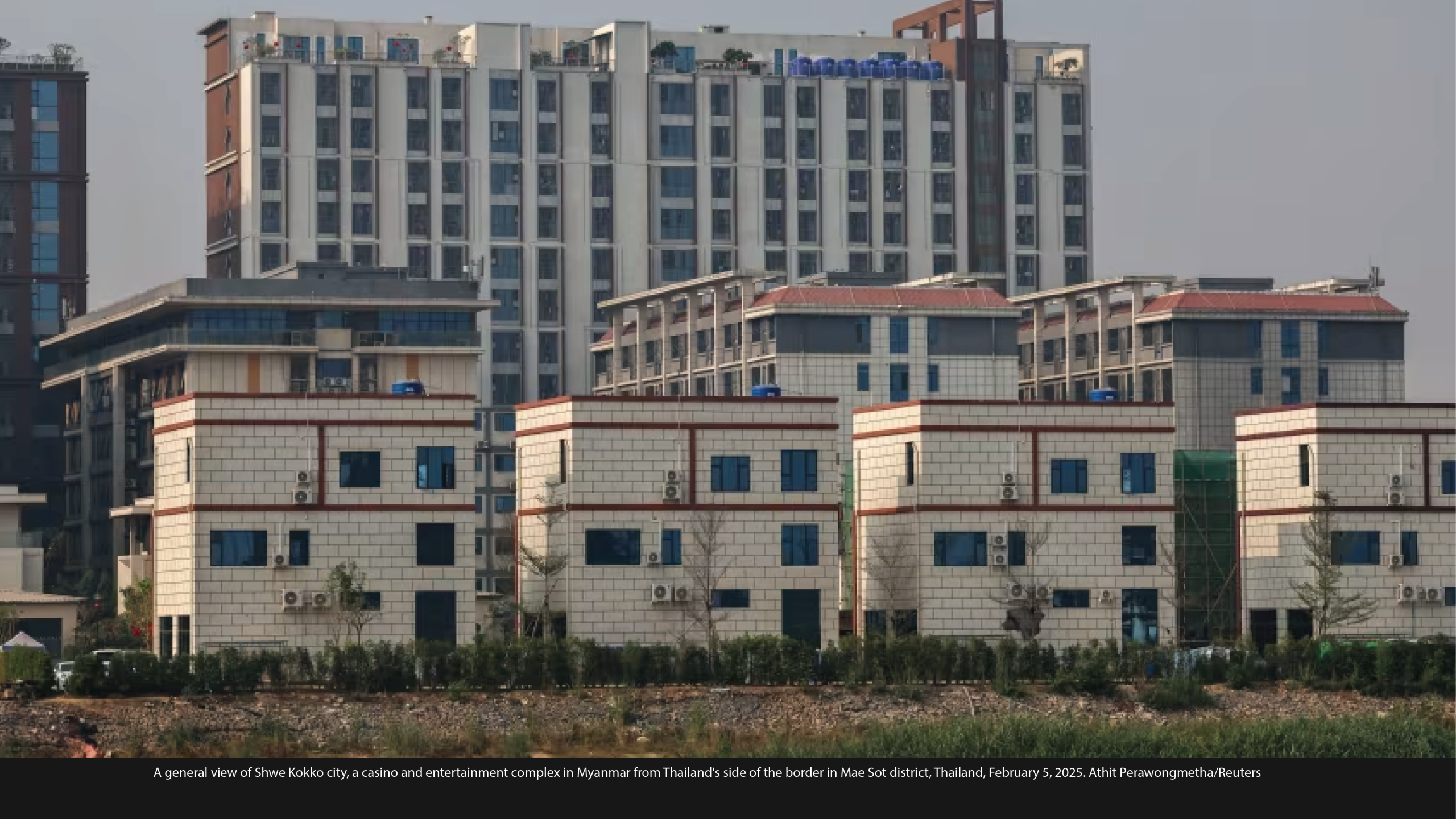
The most notorious site is called KK Park. It sits in Myawaddy, a town in Myanmar’s Karen State, directly across the river from Thailand. You can see it from the Thai side. It’s not hidden. It’s a purpose-built city. Over two hundred and fifty buildings. Paved roads. Supermarkets, restaurants, a hospital, a hotel. From satellite imagery it looks like a business park. From the inside, according to survivors and journalists who’ve been in, it operates like a prison. Armed guards on the perimeter. Workers sleeping in dormitories, monitored around the clock, unable to leave.
And KK Park is just one. There are roughly thirty known scam compounds along the Thai-Myanmar border alone. Shwe Kokko. Huanya. Apollo Park. Family Park. Dongmei Zone. And those are only the ones that have been identified. Satellite analysis by the research group C4ADS found that fourteen out of twenty-one known compounds in Myawaddy showed construction or expansion in 2025, even after international crackdowns had begun. They weren’t shrinking. They were growing. During the crackdowns.
The United Nations estimates over a hundred and twenty thousand people are held in scam operations across Myanmar. Another hundred thousand in Cambodia. INTERPOL says victims have been trafficked from sixty-six countries. A UN report in early 2026 documented survivors held in compounds some over five hundred acres in size. Over two hundred thousand people held across the region. That is not a crime ring. That is a population.
What Happens To People Inside The Compounds
I need to describe what happens inside these places. Because unless you understand what was being done to people in these buildings, the rest of this article doesn’t land the way it should.
The Pulitzer Center documented three Indonesian men held at a compound called Family Park for five months. Around two thousand workers inside. They described being forced to run in midday heat as punishment. Locked in rooms with twenty others. Punched. Electrocuted. Beaten with sticks. A Deutsche Welle investigation found seventeen-hour workdays. Constant surveillance. Workers threatened with murder for trying to escape. CNN obtained video from inside a compound showing a man being tortured with electric shocks on the floor of a bathroom while he screamed and begged them to stop.
What Pig Butchering Scams Actually Are
The scam itself is called pig butchering. You fatten the target before the slaughter. The workers are given phones, sometimes eight or ten each, loaded with fake identities and spoofed locations. They create profiles on dating apps, on Facebook, on WhatsApp, using photos stolen from real people. They build relationships with strangers. They spend weeks, sometimes months, gaining someone’s trust. Building what the victim believes is a real romance. And then they introduce a cryptocurrency investment. A fake trading platform. Rising profits that aren’t real. By the time the victim realises, their savings are gone. The people being scammed are retirees, people going through divorces, people who were lonely. People who trusted someone who was being forced at gunpoint to lie to them. Both sides are victims. One was trafficked. The other was defrauded. And the system that connects them runs through the country I live in.
The workers are prisoners. They have quotas. If they miss them, they’re punished. Many can only leave by paying a ransom calculated by how much revenue they generated. If they can’t pay, they’re sold to another compound. One Sri Lankan man, documented by International Justice Mission, was lured to Thailand for a tech job, ended up at KK Park running romance scams, and when he was finally released, his first words were that he was glad more people were coming out. Because he knew thousands were still inside. An Indian man held with eight hundred others, sharing ten toilets, asked the Associated Press a question I haven’t stopped thinking about. If we die here with health issues, who is responsible for that.
Who Saw Chit Thu Is And How The Money Flows To The Junta
The compounds sit in territory controlled by a warlord named Saw Chit Thu. He commands a militia of over ten thousand troops. His militia guards the compounds. His sons hold shares in companies that operate them. The United States Treasury designated his militia a transnational criminal organisation and sanctioned him and his sons personally. The UK and EU sanctioned him before that.
His militia hands over roughly half its earnings to Myanmar’s military junta. From one project alone, nearly two hundred million dollars a year flowing from scam operations to a military government whose leader is wanted by the International Criminal Court for crimes against humanity.
In April 2025, Thailand hosted that same military leader at a summit in Bangkok. He sat at the head table. Between prime ministers. In the country whose infrastructure, as I’m about to show you, was feeding the operations his allies profit from.
The Thai Infrastructure That Powered The Scam Industry
I expected to find turned blind eyes. Slow bureaucracy. Maybe some local corruption at the border. What I found was something I wasn’t prepared for. Not negligence. Infrastructure. Layer after layer of it. All of it Thai.
Every victim in this story landed at a Thai airport. They were driven five hundred kilometres on Thai highways, through Thai provinces, past Thai police checkpoints. They crossed at a Thai border town that has been a known trafficking corridor for years. Signs in Thai, English, and Chinese now warn people along the road to Mae Sot about the danger of being trafficked. Those signs went up in 2025. The trafficking had been running for years before anyone put up a sign.
Thailand’s National Broadcasting and Telecommunications Commission confirmed that internet connections supplying one of the largest scam hubs were running through Thai networks. The NBTC later called those connections illegal. They had been operating for years.
Thai state-owned PTT subsidiaries supplied fuel across the border. The generators that kept the compounds running were fed by Thai energy.
In November 2025, the United States Treasury sanctioned two Thai-registered companies, Trans Asia International Holding Group Thailand and Troth Star Company Limited, along with a Thai national. The Treasury said they were linked to Chinese organised crime and had worked with armed groups to develop scam centres. Trans Asia had signed land lease contracts to build compounds including the notorious KK Park. Thai-registered companies. Operating from the Thai border town of Mae Sot. Signing contracts to build the physical buildings where people from sixty countries were enslaved. That is in the United States Treasury’s published sanctions filing.
How A Thai State-Owned Utility Powered The Compounds For Eight Years
And then there’s the electricity.
Thailand’s Provincial Electricity Authority, the PEA, a state-owned utility, had formal contracts to supply power across the Myanmar border at five connection points. One of the distributors on the Myanmar side was owned by a senior officer of Saw Chit Thu’s militia. That distributor supplied Thai electricity directly to scam facilities including the area around KK Park.
The compounds had been operating since at least 2017. The trafficking had been documented for years. The UN had published reports. Survivors had told their stories. And through all of it, a Thai state-owned utility was supplying power to the areas where it was happening, under formal government-approved contracts. Six hundred million baht a year. That’s what the power was worth. That’s what Thailand was collecting while people were being enslaved on the other end of the wire.
Five hundred thousand Thai citizens were themselves victims of call centre scams between 2022 and 2024. Sixty billion baht in damages to Thailand. Eighty million baht a day in ongoing losses. Thailand’s own people were being scammed by an industry that Thailand’s own state infrastructure was helping to sustain. And still, nobody cut the power.
Why Thailand Finally Cut The Power In February 2025
Thailand finally cut the power in February 2025. Not when the first person was enslaved. Not when the first survivor spoke. Not when the United Nations warned the world. When a high-profile kidnapping made global headlines and China’s government applied direct pressure because Chinese tourism to Thailand collapsed. Flight cancellations surged a hundred and fifty percent. Thailand’s biggest source of tourist revenue was under threat. And only then did the interior minister walk into PEA headquarters and order the disconnection. He said the electricity was being used in a way that caused trouble for Thailand.
The word he used was trouble. Not slavery. Not torture. Not the systematic enslavement of over a hundred thousand people across the river. Trouble.
And even after the cut, the industry adapted within hours. Generators arrived. Solar panels had been installed months earlier in anticipation. Fourteen of twenty-one known compounds continued expanding. Eight years of uninterrupted Thai power had given the industry enough time to entrench itself so deeply that cutting the cord barely slowed it down.
This Was Not Proximity. This Was Infrastructure.
I pay an electricity bill every month in this country. To the same state utility that was billing the distributors who were powering the buildings where people from sixty countries were held as slaves and forced to steal from strangers.
This was not proximity. This was not bad luck. This was not one corrupt official at a border crossing looking the other way. Thai roads delivered the victims. Thai airports were the first door they walked through. Thai internet connected the compounds. Thai fuel ran the generators. Thai companies built the buildings. Thai electricity lit them up. And for eight years, nobody in a position of power in this country did anything about it until a foreign government told them they had to.
The people who were taken through this country didn’t just happen to pass through Thailand. They were processed through it. Like products on a conveyor belt. From the airport to the car to the road to the border to the boat to the compound. And the belt was running on Thai power.
Frequently Asked Questions
What is the Myanmar scam compound industry?
The Myanmar scam compound industry is an industrial-scale human trafficking and fraud operation generating an estimated forty billion US dollars a year, according to United Nations figures. Roughly thirty known compounds operate along the Thai-Myanmar border alone, with KK Park in Myawaddy the most notorious. The United Nations estimates over a hundred and twenty thousand people are held in scam operations across Myanmar with another hundred thousand in Cambodia. INTERPOL says victims have been trafficked from sixty-six countries. Workers are forced to run online romance and cryptocurrency fraud schemes against targets worldwide, working seventeen-hour days under threat of beating, electrocution, and resale to other compounds.
How does the trafficking pipeline through Thailand work?
Victims respond to fake job adverts on Facebook, Telegram, and LinkedIn offering positions in digital marketing, tech support, or customer service with reasonable salaries. They fly into Suvarnabhumi Airport in Bangkok, are met by a contact, and driven five hundred kilometres north through Chai Nat, Kamphaeng Phet, and into Tak Province to the border town of Mae Sot. At Mae Sot they cross the Moei River into Myanmar, have their passports and phones confiscated, their heads shaved, and are forced to begin scam work. The entire pipeline runs through Thai airports, Thai highways, Thai provinces, and Thai border infrastructure.
What is KK Park?
KK Park is the most notorious scam compound in Myanmar, located in Myawaddy, Karen State, directly across the river from Thailand. It is a purpose-built city with over two hundred and fifty buildings, paved roads, supermarkets, restaurants, a hospital, and a hotel. It looks like a business park from satellite imagery and operates as a prison from the inside, with armed guards on the perimeter and workers held in dormitories under constant surveillance.
What is pig butchering?
Pig butchering is the name for the scam method workers in the compounds are forced to run. Workers are given phones, sometimes eight or ten each, loaded with fake identities and spoofed locations. They build profiles on dating apps, Facebook, and WhatsApp using photos stolen from real people. They spend weeks or months gaining a target’s trust and building what the target believes is a real romance, then introduce a fake cryptocurrency investment platform with rising profits that are not real. By the time the victim realises, their savings are gone. The targets are typically retirees, people going through divorces, or lonely people. Both the trafficked worker and the defrauded target are victims of the same system.
What was Thailand’s role in supporting the scam compounds?
Thai infrastructure supported the scam industry across multiple layers for at least eight years. Every victim entered Thailand through a Thai airport and was driven on Thai highways to the Thai border. Thailand’s National Broadcasting and Telecommunications Commission confirmed that internet connections supplying one of the largest scam hubs were running through Thai networks. Thai state-owned PTT subsidiaries supplied fuel for the generators. The United States Treasury in November 2025 sanctioned two Thai-registered companies, Trans Asia International Holding Group Thailand and Troth Star Company Limited, along with a Thai national, for working with armed groups to develop scam centres including KK Park. And Thailand’s state-owned Provincial Electricity Authority supplied power across the border at five connection points for six hundred million baht a year.
When did Thailand cut the power to the scam compounds?
In February 2025. Not when the first person was enslaved. Not when the United Nations published its reports. The power was cut only after a high-profile kidnapping made global headlines and the Chinese government applied direct pressure because Chinese tourism to Thailand was collapsing, with flight cancellations surging a hundred and fifty percent. The interior minister then ordered the Provincial Electricity Authority to disconnect, describing the situation as causing “trouble for Thailand.” The industry adapted within hours, with generators arriving and pre-installed solar panels coming online. Fourteen of twenty-one known compounds continued expanding after the cut.
Who is Saw Chit Thu?
Saw Chit Thu is the warlord who controls the territory where most of the Myawaddy scam compounds operate. He commands a militia of over ten thousand troops that guards the compounds. His sons hold shares in companies that operate them. The United States Treasury has designated his militia a transnational criminal organisation and sanctioned him and his sons personally. The UK and EU sanctioned him earlier. His militia is reported to hand over roughly half its earnings to the Myanmar military junta, whose leader is wanted by the International Criminal Court for crimes against humanity. Thailand hosted that same military leader at a Bangkok summit in April 2025.
Sources
- United Nations OHCHR — Trafficking into Scam Centres (2023/2026) https://www.ohchr.org/en/press-releases/2026/02/un-report-details-grave-abuses-against-those-trafficked-scam-centres
- UN Office on Drugs and Crime — $40 billion annual revenue https://en.wikipedia.org/wiki/Scam_centers_in_Myanmar
- FBI IC3 — $16+ billion US losses (2024) https://www.pbs.org/newshour/world/myanmar-has-declared-a-zero-tolerance-policy-for-cyberscams-but-the-fraud-goes-on
- Council on Foreign Relations — Myanmar cyber scam overview https://www.cfr.org/in-brief/how-myanmar-became-global-center-cyber-scams
- University of Texas — $75 billion global losses 2020-2024 https://www.cfr.org/in-brief/how-myanmar-became-global-center-cyber-scams
- INTERPOL — 66 source countries (March 2025) https://scamwatchhq.com/the-2025-global-scam-landscape-a-year-of-ai-powered-deception-record-losses-and-human-trafficking/
- AP / PBS Frontline — KK Park, compounds, C4ADS satellite data https://www.pbs.org/wgbh/frontline/article/myanmar-cyberscam-scam-compound/
- Al Jazeera — KK Park raid, 30 Starlink seized https://www.aljazeera.com/news/2025/10/21/myanmar-military-arrests-more-than-2000-people-at-infamous-scam-centre
- Pulitzer Center — Family Park survivors https://pulitzercenter.org/stories/exclusive-inside-chinese-run-crime-hubs-myanmar-are-conning-world-we-can-kill-you-here
- Pulitzer Center — Romance scam compound / Sri Lanka survivor https://pulitzercenter.org/stories/inside-romance-scam-compound-and-how-people-get-tricked-being-there
- Deutsche Welle — 17-hour workdays, murder threats https://en.wikipedia.org/wiki/KK_Park
- CNN — Electric shock torture, compound conditions https://www.cnn.com/2025/04/02/asia/myanmar-scam-center-crackdown-intl-hnk-dst
- International Justice Mission — 260 freed, 19 countries https://www.ijm.org/news/nearly-260-workers-freed-myanmar-scam-compounds-identified-trafficking-victims-thailand
- PBS Frontline — Indian/Ethiopian survivor testimony https://www.pbs.org/wgbh/frontline/article/scam-centers-trafficking-myanmar/
- US Treasury — Saw Chit Thu / KNA sanctioned (May 2025) https://home.treasury.gov/news/press-releases/sb0129
- US Treasury — Trans Asia, Troth Star sanctioned (Nov 2025) https://home.treasury.gov/news/press-releases/sb0312
- USIP — BGF ~50% earnings to junta (~$192M) https://www.irrawaddy.com/news/myanmars-crisis-the-world/scam-workers-flee-as-bgf-vows-final-war-on-shwe-kokko-scam-hub.html
- Justice For Myanmar — KNA criminal network https://www.justiceformyanmar.org/stories/the-karen-border-guard-force-karen-national-army-criminal-business-network-exposed
- Al Jazeera — Min Aung Hlaing at Bangkok summit https://www.aljazeera.com/news/2025/4/4/myanmars-military-junta-chief-joins-bangkok-summit-in-rare-trip-abroad
- Lowy Institute — Thai senator / Myanmar businessman https://www.lowyinstitute.org/the-interpreter/new-thai-pm-has-his-work-cut-out-myanmar
- Irrawaddy — Thai Army Chief meets junta (March 2026) https://www.irrawaddy.com/news/politics/thai-army-chief-meets-myanmar-junta-leaders-amid-intense-us-focus-on-scam-centers.html
- Bangkok Post — PEA power cut (February 2025) https://www.bangkokpost.com/thailand/general/2954672/power-cut-off-to-scam-centres-along-myanmar-border
- The Diplomat — Electricity cut to scam sanctuaries https://thediplomat.com/2025/02/thailand-cuts-electricity-to-scam-sanctuaries-across-myanmar-border/
- CNN — Power cut, compounds continue https://www.cnn.com/2025/02/05/asia/myanmar-thailand-scam-power-cuts-intl-hnk
- RFA — Myit Shwe Thaung Ying Company / BGF https://www.globalsecurity.org/wmd/library/news/myanmar/2025/myanmar-250204-rfa03.htm
- Khaosod English — 600M baht, Anutin quotes https://www.khaosodenglish.com/politics/2025/02/05/thailand-cuts-power-supplies-to-myanmar-border-towns-in-effort-to-curb-scam-rings/
- The Star — 500,000 Thai victims, 60bn baht https://www.thestar.com.my/aseanplus/aseanplus-news/2025/02/04/thailand-to-cut-power-supply-to-myanmar-scam-cities
- Irrawaddy — Business as usual post-raid https://www.irrawaddy.com/news/burma/business-as-usual-at-myawaddy-scam-hubs-after-myanmar-juntas-kk-park-raid.html
- OCCRP — US sanctions, $5.5bn losses https://www.occrp.org/en/news/us-sanctions-myanmar-militia-tied-to-global-scam-empire-human-trafficking
- Wikipedia — KK Park / Scam centers in Myanmar / Saw Chit Thu https://en.wikipedia.org/wiki/KK_Park