The One Place In Southeast Asia I Have Refused To Visit
I have lived in Southeast Asia for a long time. I have travelled, lived, written about and built a life across most of this region. I have made my peace with most of what Southeast Asia has become, the things I love and the things I do not, the changes I have welcomed and the changes I wish had not happened. There is one place, however, in this entire region, that I have actively avoided. One place I have refused to visit despite it being one of the cheapest and easiest destinations from where I live. One place that, when other expats mention they are going there, I quietly remove myself from the conversation because I do not want to be impolite about somewhere they are excited about.
That place is Bali.
I will not go to Bali. I have not been. I am not going. I cannot envisage any scenario in which I would willingly buy a ticket to Denpasar and spend my own money on the experience of being in that part of Indonesia. And in this article I want to explain why, because I think the reasons are worth writing down, and because Bali is one of the clearest examples I can point to of what has gone wrong with Southeast Asian tourism over the last fifteen years.
Let me be specific about what I mean. I am not talking about Indonesia. I wrote a full article recently making the case that Indonesia is one of the most interesting countries in Southeast Asia for the Western foreigner who is prepared to look past the cliché, and I meant every word of it. Yogyakarta is fascinating. Bandung is fascinating. Surabaya and Solo and Malang are worth a Western foreigner’s time. The cultural depth of Java, the Sumatran traditions, the Sulawesi maritime cultures, the food, the heritage, the actual country, is a serious destination that deserves more attention than it gets. None of what I am about to say applies to Indonesia.
What I am about to say applies to Bali. And specifically, to what Bali has become in the last fifteen years.
The Sort Of Foreigner Bali Now Attracts
The first thing that needs to be said clearly, because almost nobody in the expat space will say it directly, is that the people Bali attracts in 2026 are not the people you want to be around if you have any interest in Southeast Asia as it actually is.
Bali, in the form it has taken since roughly 2015, has become an international expat colony that exists in a kind of dreamlike floating relationship to the country it sits in. The Western foreigners who go there, particularly the digital nomad and wellness-influencer demographic that has come to dominate Canggu and Ubud, are not interested in Indonesia. They are not interested in Bali itself either, in any meaningful sense. They are interested in a particular fantasy of tropical lifestyle, mediated through Instagram, that happens to use Bali as its backdrop. The yoga retreats. The cold plunges. The morning sound baths. The wellness coaches who have done a six-week certification and now charge two hundred dollars an hour. The performative spirituality borrowed loosely from a Hindu tradition that most of them could not name the basic elements of. The endless content production. The chasing of the same handful of waterfall and rice-terrace photo locations that every other influencer has already used. The constant cycle of arrival, performance, departure, replacement.
These are not, broadly speaking, people who would last five minutes in actual Southeast Asia. They would not survive a week in a Bangkok soi where nobody speaks English to them by default. They would not handle a Vientiane border run. They would not know what to do in a Phnom Penh tuk-tuk negotiation. They would not be able to navigate a Penang hawker centre on their own without consulting four travel apps first. They have been carefully selected, by the texture of Bali itself, as the foreigners least equipped to engage with Southeast Asia on its own terms, and they have found in Bali a destination that has been progressively engineered to make sure they do not have to.
The cafes serve almond milk flat whites. The signs are in English first and Indonesian second. The wellness retreats price themselves in US dollars. The conversations in the coworking spaces are about personal brands and conversion rates and the algorithms of platforms that did not exist when most of us came to Southeast Asia. The Indonesian people in these spaces are, in any honest visual assessment, working there rather than living there. They are the staff. The customers are foreign. The relationship between the customer and the staff is the same hospitality-industry relationship you find in any tourist enclave in the world, with the cultural exchange minimal and the financial extraction substantial.
This is not what Southeast Asia is supposed to be. This is not what the Western foreigner came to Southeast Asia for in the 1990s or the 2000s. This is a particular pathology of the post-2015 international remote-work economy that has selected Bali, among all the destinations it could have selected, as the place to concentrate its worst features. The Bali I would have to visit if I went there now is not Indonesia. It is a kind of floating non-place, neither East nor West, that has installed itself on a Hindu Indonesian island and turned the island into a backdrop for its own self-promotion.
The Disrespect Of A Living Religious Culture
The second thing that needs to be said is that the foreigners going to Bali, in measurable numbers, treat the religious and cultural life of the island with a level of contempt that the Balinese have, at this point, run out of patience with.
The Balinese province deported nearly 130 foreign tourists in the first three months of 2025 alone, more than one per day on average. 157 foreigners were deported in the first eight months of 2024, with 194 more held in detention awaiting deportation. The Russian influencer Alina Fazleeva was deported in 2022 for climbing and posing naked on the Kayu Putih, a sacred 700-year-old banyan tree on Hindu temple grounds in Tabanan district. The Canadian “mind-body healer” Jeffrey Craigen was deported in the same period for streaming himself dancing naked on a sacred volcano while also performing a Maori haka. A Danish tourist was detained after exposing herself in public. A German woman walked naked into a Bali temple. A Russian man was deported after posting a photograph of himself half-naked atop one of the sacred mountains, which in Balinese Hindu culture are revered as the dwelling places of gods and ancestors. There are documented reports of Western tourists masturbating under sacred waterfalls. A 27-year-old American man was deported in 2025 for a violent outburst at a local medical clinic involving throwing furniture and tearing down curtains and frightening other patients.
This is what the Balinese have been dealing with. These are not isolated incidents. These are the consequences, played out repeatedly across every quarter of every recent year, of a particular kind of foreigner being concentrated on a particular Indonesian island and being given the implicit permission of the tourism economy to behave as if the place around him is a stage set rather than a living religious culture.
The Balinese Hindu tradition is one of the oldest continuously practised forms of Hinduism in the world, dating back to the introduction of Hinduism to the Indonesian archipelago in the first millennium. It survived the Islamic conversion of the rest of the archipelago. It survived Dutch colonisation. It survived the political violence of the 1960s. It survived the 2002 and 2005 bombings. It has been the foundation of the entire cultural and social life of the island for more than a thousand years. The temples are not props. The mountains are not Instagram backdrops. The sacred trees are not photo opportunities. The ceremonies the Balinese hold throughout the year are not folk entertainment for the foreign visitor.
The foreigners who go to Bali in 2026 are, in measurable proportions, treating all of this as if it were a theme park. The Balinese government has had to introduce Circular Letter Number 7 of 2025, an updated version of the 2023 regulations, which lists specific obligations and prohibitions for foreign tourists including dress codes at temples, prohibitions on swearing in public, bans on entering sacred areas without permission, prohibitions on climbing sacred trees, and a dedicated WhatsApp hotline for locals and businesses to report misconduct. The Governor of Bali has proposed banning hiking on the sacred mountains altogether because of the repeated incidents of foreigners stripping naked on them. The fact that a regulation of this kind even has to be issued is the clearest possible indictment of what the foreign presence on the island has become.
When the host culture has to publish a list of basic civilisational expectations because the guests cannot be relied upon to dress modestly in a temple, the relationship between the host and the guest has fundamentally broken down. The Balinese have been more patient about this than they had any obligation to be. The behaviour of the foreigners going there in 2026 does not justify the patience.
The Destruction Of The Physical Place
The third thing that needs to be said is that, beyond the cultural disrespect and beyond the type of foreigner being attracted, the physical place itself has been systematically destroyed by the speed and the scale of the tourism boom.
Canggu, until about 2015, was a quiet farming village on the southwestern coast with rice paddies and a small surf scene. Today it is a single continuous traffic jam of scooters and concrete from Berawa to Pererenan, with villas piled on top of villas, the rice fields progressively built over, the local Balinese population progressively priced out, and the famous beachfront a strip of bars, beach clubs, and Instagram-bait architecture that bears no resemblance to anything Balinese. Villa prices in Canggu have reportedly doubled since pre-2024 levels. Bali now has the highest rent index of any non-Singapore city in Southeast Asia according to Numbeo data. The cost of basic accommodation in the most heavily visited Bali zones is now higher than in Bangkok or Kuala Lumpur, in a country whose national GDP per capita is a fraction of either.
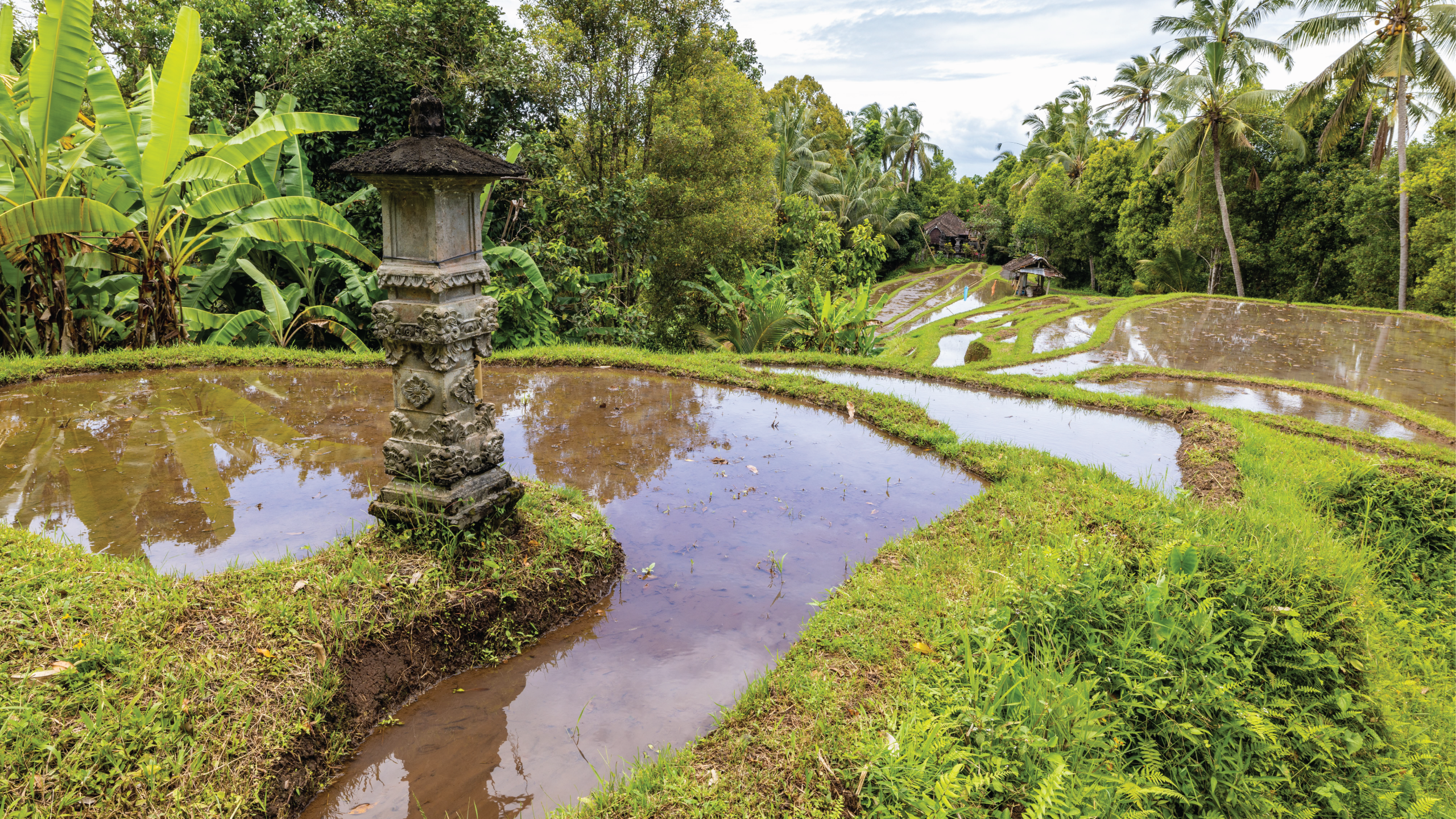
Ubud, the historic cultural heart of the island, has been progressively transformed from a temple town with serious art and dance traditions into a Western wellness retreat zone with vegan cafes, organic restaurants, yoga shalas on every corner, and the same set of influencer cafes that exist in Canggu. The rice fields outside Ubud, the Tegallalang terraces that should be one of the cultural and agricultural treasures of the world, have been turned into a photo-stop conveyor belt with paid swings and ticket booths. The Lempuyang Temple gates, where pilgrims used to go for genuine religious experience, have been turned into the most-photographed Instagram location on the island, with queues of foreign tourists waiting for their turn at the famous reflection shot, and the actual Hindu function of the site has been progressively displaced by the photographic function.
Bingin, on the Bukit peninsula, is the most concrete symbol of what has happened to the island. In 2024 over 40 villas at Bingin were demolished by the Indonesian authorities because they had been built in violation of zoning and permit regulations on protected cliff land. Foreign developers and foreign owners had simply built where they were not supposed to build, on the assumption that the local enforcement would never catch up with them. The enforcement did catch up. The villas came down. The foreigners who had put their money into those properties lost everything. This is what unregulated foreign-led development of a fragile tropical environment looks like when the host country finally decides it has had enough.
Sacred sites have had to introduce strict visitor caps and timed entry. The most popular beaches now routinely appear on “most disappointing” lists in travel publications because they are choked with plastic and crowded with sun loungers. European and Australian tour operators are reporting booking declines for 2025-2026 compared to the post-pandemic peaks of 2024 because the country has become, by its own visitors’ assessment, too crowded and too commercialised to be the experience that was being sold. Travellers who once dreamed of Bali are now actively asking for the “next Bali,” with Lombok, Sumba, and even Sri Lanka and the Philippines being floated as alternatives.
Bali has been, in functional terms, used up. The physical environment has been degraded by overdevelopment. The cultural environment has been degraded by the type of foreigner attracted. The economic environment has been distorted by foreign capital pricing out the local population. And the marketing of the island that made all of this possible is now starting to lose its grip as the global travel market wakes up to what the island has actually become.
The Foreigners Who Do Not Belong In Southeast Asia
This is the part I want to be direct about, because it is the part that the expat community in Southeast Asia very rarely says out loud.
There is a particular type of Western foreigner who has come to Southeast Asia in the last decade who does not belong here. I do not mean this in any ethnic or national sense. I mean it in the practical, observable sense that some foreigners come to this region prepared to engage with it on its own terms, and others come to this region looking for a backdrop against which to perform a version of themselves that they could not perform at home. The first kind learn the language, eat the food, build relationships with local people, accept the imperfections of the host country, and become, over time, a recognisable feature of the place they have moved to. The second kind do none of that. They arrive with their own social media following, they install themselves in a foreigner-dominated enclave, they curate the parts of the host culture that work for their content, they extract from the local economy without contributing to it in any durable way, and they leave again when the next destination becomes fashionable. Bali, more than any other place in Southeast Asia, has been built to serve the second kind.
The wellness coach who has been in Bali for six months and is now selling chakra alignment workshops to other foreigners is not a foreigner who has engaged with Indonesia. The digital nomad who has been in Canggu for a year and has never had a meaningful conversation with a Balinese person who was not serving him is not a foreigner who has engaged with Indonesia. The influencer who has done the Lempuyang gate shot and the Tegallalang swing and the Kelingking Beach selfie and the Mount Batur sunrise has not engaged with Indonesia. They have engaged with a curated set of photo opportunities on Indonesian territory. That is a different thing.
These foreigners would not have lasted in the Bangkok of 2005, when I came. They would not have lasted in Vientiane in 2010, when I went for the first time. They would not last in Yangon now, or in proper Java, or in much of the Philippines, or in any part of Southeast Asia that has not been pre-processed for foreign consumption. They have selected Bali because Bali has been pre-processed for foreign consumption to a degree that no other destination in Southeast Asia has matched. And in selecting Bali, they have made themselves a kind of self-identifying community of foreigners who do not, in the deeper sense, belong in Southeast Asia at all.
I will not be among them. I will not put myself in a place where the dominant foreign culture is the wellness-influencer-remote-worker complex that has colonised the island. I will not sit in a Canggu cafe surrounded by twenty-somethings whose entire understanding of Southeast Asia is mediated through a phone screen. I will not participate in a tourist economy that has demonstrably degraded the cultural and physical environment of one of the great Indonesian islands.
What Bali Should Have Been
Bali, in a parallel universe, could have been one of the great cultural destinations of Southeast Asia. The island has everything. A unique Hindu tradition in a Muslim-majority country. A genuinely sophisticated art and dance tradition. Beautiful highland country. World-class surfing. A food culture with serious depth. A climate that allows tropical agriculture year-round. A geographic position that makes it accessible from Australia, Singapore, and the major Asian capitals. If the Indonesian government had managed the foreign tourism boom of the last fifteen years with even moderate restraint, if the development controls had been enforced from the start, if the foreign behaviour had been disciplined earlier, if the visa system had restricted the worst of the digital nomad and influencer demographic before it became culturally dominant, Bali could have been the Penang of Indonesia. A heritage destination. A respected cultural centre. A place where serious foreigners came for serious reasons.
Instead, it has been Sihanoukville-without-the-casinos. A place that has been remade by foreign capital and foreign behaviour in ways that have substantially degraded the original character of the destination. The Balinese have done their best to resist this and to introduce regulation late in the process, but the damage is largely done. The cultural texture, the architectural texture, the demographic texture of the heavily visited zones has been altered in ways that will take generations to reverse, if they can be reversed at all.
I look at this from across the water in mainland Southeast Asia, and I see what has happened to Bali, and I see no scenario in which spending my own money to participate in the result is something I would willingly do. The country I would have to fly to is not the country I would want to be in. The foreigners I would be surrounded by are not the foreigners I would want to spend time with. The cultural experience I would be paying for is not the cultural experience that the marketing claims it is.
Why I Choose The Rest Of Southeast Asia Instead
There are other Indonesian islands. There are other Indonesian provinces. There is the rest of Southeast Asia, all of it, every country, every region, every smaller city, every village outside the well-trodden tourist circuit, every quiet corner of every neighbouring country that has not been turned into a backdrop for foreign content production. All of it is more interesting to me than Bali. All of it is more honest. All of it is more recognisably Southeast Asia.
I would rather spend a week in a small Javanese town that nobody has heard of than spend a day in Canggu. I would rather drink instant coffee in a Sumatran roadside stop than pay twelve dollars for a Canggu flat white. I would rather sit on a deserted beach in the Mentawai islands than fight for space on the Bingin sand. I would rather have a real conversation with a Sulawesi fisherman than overhear another Canggu wellness coach explaining her chakras to her American client. These are not abstract preferences. These are the actual choices I make every time I plan a trip, and every time I plan a trip Bali is at the bottom of the list and remains there.
I think the long-term Western foreigner who has spent significant time in this region has, almost without exception, the same response to Bali that I do. The Bangkok expats I know who have been here as long as I have do not go. The Penang expats do not go. The Phnom Penh expats do not go. The Vientiane expats do not go. The Manila expats do not go. We have all watched what happened to the island and we have all made the same decision. The foreigners who do go are the ones who have not yet seen what the rest of Southeast Asia actually looks like, or the ones who do not want to see, or the ones who have selected themselves as the kind of foreigner who needs the kind of place that Bali has become.
I am not that foreigner. I will not be that foreigner. I will continue to live in mainland Southeast Asia, to travel in mainland Southeast Asia, to visit the islands and the smaller cities and the parts of Indonesia that are not Bali, and to write about what Southeast Asia actually is rather than the version of it that has been packaged for influencer consumption on one heavily marketed Hindu Indonesian island.
That is why I will never go to Bali. The place is not what it should be. The foreigners going there are not the foreigners I want to be among. The cultural disrespect, the physical degradation, the price distortion, the demographic transformation, the loss of what the island used to be, are all reasons to stay away. The fact that there are so many alternatives, that the rest of Southeast Asia is still genuinely available to anyone willing to look beyond the brochure, is the reason there is no excuse to choose Bali anyway. I have chosen the rest of Southeast Asia. I will keep choosing the rest of Southeast Asia. And Bali, for as long as I am living in this region, will remain the one place I have refused to visit and the one place I never intend to.
Frequently Asked Questions
Has Bali always been like this, or has something changed?
Bali has changed dramatically in the last fifteen years. Until roughly 2010 the island was a relatively well-balanced cultural destination with a mix of serious cultural tourism, surfing tourism, and the kind of resort tourism that exists across much of Southeast Asia. The transformation into the influencer and wellness-retreat colony described in the article accelerated after about 2015, with the digital nomad boom of the late 2010s and the COVID-era remote-work shift completing the demographic capture of zones like Canggu and Ubud. The Balinese cultural and religious traditions are still there, but they are now embedded inside a heavily commodified tourism economy that has progressively displaced them in the most-visited areas.
How many foreign tourists are being deported from Bali?
The deportation numbers have been documented by the Bali Regional Office of the Ministry of Law and Human Rights. Nearly 130 foreign nationals were deported in the first three months of 2025 alone, an average of more than one per day. 157 foreigners were deported in the first eight months of 2024 with 194 more held in detention awaiting deportation. 70 foreign nationals were deported between January and early April 2023. The deportations are for a mix of overstays, misuse of immigration permits, illegal work, sacred-site disrespect, public nudity, and other legal violations. Russian nationals have been over-represented in the deportation figures across multiple years.
What is Circular Letter Number 7 of 2025?
Bali Governor Wayan Koster’s regulation issued on 24 March 2025 setting out guidelines and obligations for foreign tourists visiting the island. The circular requires foreigners to respect sacred sites and symbols, dress modestly at temples, refrain from entering sacred areas without permission, avoid climbing holy trees, avoid swearing or causing disturbances in public, refrain from sharing hate speech or misinformation on social media, exchange foreign currency only at authorised money changers, and engage licensed tour guides when visiting cultural and natural sites. Foreigners are also prohibited from working or running a business without proper permits. The regulation includes a dedicated WhatsApp hotline (+62 812-8759-0999) for locals and businesses to report misconduct, with reports funnelled to Bali’s Civil Service Police Unit and regional police for investigation.
What were the major sacred-site incidents?
Several high-profile incidents have driven the regulatory tightening. Russian influencer Alina Fazleeva was deported in 2022 for climbing and posing naked on the Kayu Putih, a sacred 700-year-old banyan tree on Hindu temple grounds in Bali’s Tabanan district. Canadian “mind-body healer” Jeffrey Craigen was deported around the same period for streaming himself dancing naked on a sacred volcano while also performing a Maori haka. A Danish tourist was detained after exposing herself in public. A German woman walked naked into a Bali temple. A Russian man was deported in 2023 after posting a photograph of himself half-naked atop a sacred mountain. A Russian blogger bared his backside on a volcano. Documented reports also exist of Western tourists masturbating under sacred waterfalls. The cumulative effect of these incidents was substantial enough to drive the proposal of a hiking ban on Bali’s sacred mountains altogether.
What happened at Bingin in 2024?
Over 40 villas at Bingin on the Bukit peninsula were demolished by Indonesian authorities in 2024 because they had been built in violation of zoning and permit regulations on protected cliff land. The villas had been developed by foreign capital and were largely occupied or owned by foreigners. Foreign developers had built where they were not supposed to build on the assumption that the local enforcement would never catch up with them. When the enforcement did catch up, the structures came down. The Bingin case has become the most prominent recent example of unregulated foreign-led development in Bali running into the limits of what the Indonesian state will tolerate.
Is the cost of living in Bali still cheap?
No, not in the heavily visited zones. Villa prices in Canggu have reportedly doubled since pre-2024 levels. Bali now has the highest rent index of any non-Singapore city in Southeast Asia per Numbeo data, with an index of approximately 32.2. The cost of accommodation in Canggu, Seminyak, Ubud, and Uluwatu is now higher than in Bangkok, Kuala Lumpur, or Ho Chi Minh City in many categories. Western-oriented restaurants, cafes, wellness services, and coworking spaces in Bali charge prices closer to Western city levels than to Southeast Asian regional norms. The rest of Indonesia (Yogyakarta, Bandung, Surabaya, Solo, Malang) remains dramatically cheaper than Bali for equivalent quality of life.
What kind of foreigners go to Bali now?
The dominant foreign demographic in the most-visited Bali zones in 2026 is the digital nomad and wellness-influencer community. Western remote workers, Russian visitors (who have surged in numbers since 2022), Australian short-stay tourists, and a smaller number of European and American long-stay foreigners. The Canggu-Ubud-Uluwatu corridor has become an international expat colony with English as the dominant working language, US dollar pricing in many establishments, and a foreigner-oriented service economy that operates largely separately from local Balinese economic life. The article’s argument is not that all foreigners in Bali fall into this category but that the demographic balance has shifted so far in this direction that the dominant foreign culture on the island is now defined by it.
Why does the article not focus on the Balinese themselves?
Because the article is about the Western foreigner’s choice to engage with Bali or not, written from the perspective of a long-term Western foreigner in Southeast Asia. The Balinese themselves are a sophisticated, ancient, and dignified culture who have been more patient with the foreign visitor invasion than they had any obligation to be, and who have introduced reasonable regulatory measures to defend their cultural and physical environment as the foreign behaviour has worsened. The article’s argument is that the foreigners going to Bali in 2026 do not deserve the patience the Balinese have shown them, and that the responsible response from any foreigner who has the choice is to engage with the rest of Indonesia (and the rest of Southeast Asia) instead.
Are there parts of Bali that have not been ruined?
Yes. The north and east of the island remain substantially less developed than the southern Canggu-Uluwatu-Ubud corridor. Northern Bali around Lovina and the area around Mount Agung in the east retain elements of the older Balinese cultural and physical landscape. The Mentawai islands further west are entirely different in texture. The point of the article is not that every square metre of Bali has been ruined. The point is that the dominant cultural and demographic experience of Bali in 2026 is the heavily visited zones, that those zones have set the brand of the island in the foreign mind, and that the existence of less-developed pockets does not redeem the broader transformation of what the island has become.
What should foreigners do instead of going to Bali?
Go to the rest of Indonesia. Yogyakarta is one of the most culturally rich destinations in Southeast Asia. Bandung is a serious city with colonial heritage and a temperate highland climate. Surabaya is the second city of Indonesia and a real working metropolis. Solo and Malang and Semarang are mid-sized Java cities with deep cultural traditions. Lombok offers the beach and surf experience without the Bali commodification. Sumba and Flores in the Lesser Sundas remain genuinely off the foreign-tourist circuit. The Mentawai islands offer world-class surfing without the Bali demographic. Sumatra, Sulawesi, the Maluku islands, and West Papua are open to anyone willing to engage with Indonesia on its own terms. Beyond Indonesia, every other country in Southeast Asia, in its non-tourist-trap form, offers a more honest and more rewarding experience than Bali does in 2026. The choice not to go to Bali is not the choice not to travel. It is the choice to travel better.
Sources
- Bali Provincial Government — Circular Letter Number 7 of 2025 (Surat Edaran Gubernur Bali Nomor 7 Tahun 2025), the official regulation issued by Bali Governor Wayan Koster on 24 March 2025, the updated version of SE Number 4 of 2023. The circular sets out the obligations and prohibitions for foreign tourists visiting Bali including respecting sacred sites and religious symbols, dress codes at temples, prohibitions on entering sacred areas without permission, restrictions on swearing or causing disturbances in public, prohibitions on hate speech and misinformation on social media, restrictions on currency exchange to authorised money changers, requirements to engage licensed tour guides for cultural and natural sites, and prohibitions on working or operating businesses without proper permits
https://lovebali.baliprov.go.id/article/detail/1742819770564/bali-cracks-down-on-unruly-tourists:-governor-koster-issues-new-regulations - Focus on Travel News — Bali Introduces New Guidelines To Curb Bad Tourist Behaviour, published July 2025, the regional travel news reporting confirming that Bali Governor Wayan Koster confirmed nearly 130 foreign nationals were deported from Bali during the first three months of 2025 alone, equal to more than one person every day on average. The piece confirms the specific case of a 27-year-old American man deported from Bali after a violent outburst at a local medical clinic involving aggressively damaging property, throwing furniture, tearing down curtains, and frightening other patients
https://ftnnews.com/travel-news/tours/bali-introduces-new-guidelines-to-curb-bad-tourist-behaviour/ - Travel And Tour World — Bali Cracks Down on Unruly Tourists New Stricter Rules to Preserve Culture, published September 2024, the international travel publication’s documentation of the specific cases including the Russian man deported in 2024 after posting a photograph of himself half-naked atop a sacred mountain (in Balinese Hindu culture revered as the dwelling places of gods and ancestors), the Danish tourist detained after exposing herself in public, and the official figure of 157 foreign tourists deported in the first eight months of 2024 with 194 more held in detention awaiting deportation
https://www.travelandtourworld.com/news/article/bali-cracks-down-on-unruly-tourists-new-stricter-rules-to-preserve-culture-impact-global-travel/ - Pedestrian TV — Balinese Officials Are Deporting An Influencer For Disrespecting A Sacred Site, published May 2022, the documentation of the case of Russian influencer Alina Fazleeva (self-titled “yogi”) deported from Bali after posting pictures of herself climbing and posing naked on the Kayu Putih, a sacred 700-year-old banyan tree located on Hindu temple grounds in Bali’s Tabanan district. The piece also documents the parallel case of Canadian actor and self-titled “mind-body healer” Jeffrey Craigen deported around the same period for streaming himself dancing nude on a volcano sacred to Balinese Hindus while also appropriating the Maori Haka
https://www.pedestrian.tv/news/influencer-bali-tree/ - National Geographic — Tired of Disrespectful Tourists Bali Imposes Hiking Bans, published June 2023, the documentation of Bali Governor Koster’s proposal to ban hiking on Bali’s sacred mountains altogether following years of foreign tourist misbehaviour at sacred sites. The piece confirms the specific incidents including a German woman who walked naked into a Bali temple, a Russian woman who posed nude on a sacred banyan tree, and a Russian blogger who bared his backside on a volcano. Over a hundred people had been deported from Bali in the year of publication alone
https://www.nationalgeographic.com/travel/article/new-bali-tourist-laws - Washington Post — Bad Tourists in Bali Are Getting Deported Testing Locals Patience, published April 2023, the American international newspaper’s documentation of the rising deportation rate of foreign tourists from Bali, the uptick in unruly behaviour following the post-COVID reopening, and the Indonesian official response to the foreign tourist behaviour problem. The piece is one of the foundational mainstream Western press confirmations of the broader pattern documented across multiple incidents
https://www.washingtonpost.com/travel/2023/04/11/bali-bad-tourists-deported/ - Databoks Katadata — Bali Sees Drop in Foreign Tourist Arrivals February 2023 Impact of Viral Misbehaving Foreign Tourists Deportation, the Indonesian economic data publication’s analysis confirming that 70 foreign nationals were deported by Bali Regional Office of the Ministry of Law and Human Rights from January to early April 2023, with the most deportations being of Russian nationals. The deportations were across three categories: overstaying, misuse of immigration permits, and other legal violations. The piece confirms that foreign tourist arrivals to Bali dropped following the virality of misbehaviour videos
https://databoks.katadata.co.id/en/tourist/statistics/3fe4d36250e92d7/bali-sees-drop-in-foreign-tourist-arrivals-in-february-2023-impact-of-viral-misbehaving-foreign-tourists-deportation - Travel And Tour World — Bali Tightens Immigration Rules as Influencer Crackdown Redefines Digital Nomad Work, the international travel publication’s recent documentation of the policy shift redefining what constitutes work within Indonesian territory, including the official Indonesian position that exchanging hotel stays, meals, experiences, or tourism services for promotional social media exposure constitutes economic activity that may require a different visa category. The piece confirms the structural concerns about overtourism, tax compliance, cultural preservation, and unregulated commercial activity in Bali driving the enforcement direction
https://www.travelandtourworld.com/news/article/zqvgh09os5j8/ - Travel And Tour World — Bali’s Digital Paradise Tightens Its Gates as Visa Crackdowns Remote Work Enforcement and Influencer Regulations Reshape the Island’s Booming Nomad Tourism Landscape, published May 2026, the comprehensive documentation of the enforcement campaign targeting foreigners suspected of misusing tourist visas for work-related activities including remote employment, sponsored online content, freelance services, and commercial collaborations. The piece confirms that digital nomads and social media influencers have emerged as primary targets within the broader immigration enforcement campaign and that Indonesian immigration officials have increasingly argued that many foreign nationals have been using tourist visas while engaging in commercial activities
https://www.travelandtourworld.com/news/article/balis-digital-paradise-tightens-its-gates-as-visa-crackdowns-remote-work-enforcement-and-influencer-regulations-reshape-the-islands-booming-nomad-tourism-landscape/ - Travel And Tour World — Bali’s Tourism Strain The Gap Between Instagram Dreams and Reality, published September 2025, the documentation of the contrast between Bali’s heavily marketed Instagram image and the lived experience of arriving visitors. The piece confirms that famous attractions including Uluwatu, Seminyak, and Canggu are now packed with tourists, that once peaceful roads have turned into chaotic traffic zones, that locals have mixed feelings about tourism prosperity coexisting with rising living costs and overdevelopment, and that quieter north and east of the island are beginning to attract those seeking more authentic experience
https://www.travelandtourworld.com/news/article/balis-tourism-strain-the-gap-between-instagram-dreams-and-reality/ - Tourism Review — Great Troubles for Bali’s Tourism Paradise, published November 2025, the international tourism industry publication’s documentation of the booking declines for 2025-2026 relative to post-pandemic 2024 highs, the searches for “the next Bali” from travellers who once dreamed of Bali, with alternatives being floated including Lombok, Sumba, Sri Lanka, and the Philippines. The piece confirms that hotels in Canggu and Ubud are reporting average daily rates in shoulder seasons approximately 10-15 per cent lower than 2023 levels in real terms, that once top-rated beaches now appear on “most disappointing” lists, and that sacred sites including Tanah Lot and Besakih Temple have instated strict visitor limits and timed entry
https://www.tourism-review.com/balis-tourism-paradise-needs-to-cope-with-overtourism-news15203 - Miniwanderlust — What is Overtourism in Bali Indonesia Cant Take It Anymore, published October 2025, the documentation of the Bali overtourism crisis confirming that Instagram has had a huge influence on overtourism in Bali, with places like Lempuyang Temple and Tegenungan Waterfall having become “viral spots” causing daily overcrowding and distorting the spiritual experience. The piece confirms that the arrival of digital nomads has driven up rental costs in central areas, pushing many Balinese to leave their villages to make way for luxury villas or coworking spaces, that Bali welcomed more than 6 million visitors in 2019, and that Bingin became the perfect symbol of the transformation with 40 villas demolished in 2024 due to zoning and permit violations
https://miniwanderlustteam.com/what-is-overtourism-in-bali/ - Sumba Sunset Cliff — Can Foreigners Own Land in Indonesia 2025 Legal Guide, published June 2025, the practical legal guide confirming the documented case of over 40 villas in Bingin (Bali) demolished in 2024 due to violations of zoning and permit regulations on protected cliff land. The piece confirms that responsible foreign property development in Indonesia requires pre-zoned land certified for HGB and guidance to ensure all building and business activities align with local law, with the Bingin demolitions serving as the canonical recent example of unregulated foreign-led development running into the limits of Indonesian state enforcement
https://sumbasunsetcliff.com/post/foreign-ownership-indonesia-land-guide - The Thaiger — Has Thailand Lost Its Edge Comparing Expat Life Across Southeast Asia, published February 2026, the regional comparison analysis confirming that Bali villa prices in Canggu have reportedly doubled since pre-2024 levels, giving Bali the highest rent index (32.2) of any non-Singapore city in Southeast Asia according to Numbeo data. The piece confirms that Indonesia’s Second Home Visa provides 5-10 years requiring a USD 130,000 deposit or property purchase, that Bali’s price level has moved beyond what is sustainable for the bulk of the long-term Western foreign community in the region, and that comparable Southeast Asian destinations have continued to offer more accessible long-term residency options
https://thethaiger.com/travel/thailand-travel/has-thailand-lost-its-edge-comparing-expat-life-across-southeast-asia - Bali Holiday Secrets — Is Bali Overcrowded in 2026 The Truth Beyond Social Media, the recent documentation confirming that Canggu and Ubud have become the main targets of social media complaints, with both areas experiencing significant growth with trendy cafes, co-working spots, and luxury villas. Canggu in particular has been transformed into a hub for digital nomads with more people, more scooters, and more traffic. The piece confirms the broader pattern of the heavily visited zones being saturated with the digital nomad and foreign expat demographic while the rest of the island remains quieter
https://www.baliholidaysecrets.com/bali-overcrowded/ - Fox News — Bali Struggling With Misbehaving Influencers as Tourism Returns, the major US news organisation’s documentation of the post-COVID return of tourism to Bali coinciding with a rise in incidents involving influencers and pranksters. The piece confirms that Bali officials had to speak out after a string of high-profile influencer incidents and that the behaviour of certain foreign social media creators became a recognised problem requiring active enforcement action by Bali’s immigration and law enforcement agencies
https://foxnews.com/travel/bali-struggling-misbehaving-influencers-tourism-returns.amp - Di Jiwa Sanctuaries — Bali Tourist Ban 2025 New Laws 9.24 USD Fee and Sacred Site Rules, the documentation of the IDR 150,000 (approximately USD 9.24) tourism levy introduced under Circular Letter Number 7 of 2025, the prohibition list including public nudity, profanity, social media posts deemed hateful or misleading, illegal activities including unauthorised work, wildlife trafficking, and trading cultural artifacts. The piece confirms the WhatsApp hotline (+62 812-8759-0999) allowing locals and businesses to report misconduct with reports funnelled to Bali’s Civil Service Police Unit (Satpol PP) and regional police for investigation
https://dijiwasanctuaries.com/magazine/indonesia-s-bali-bans-naughty-tourists-bali-s-new-30-tourist-tax-and-strict-laws - Bali Provincial Government LoveBali Portal — Official Tourism Guidelines and Regulations, the official Indonesian provincial government portal documenting the comprehensive set of obligations for foreign tourists including respecting sacred sites and symbols (temples, religious statues or pratima, and other holy places), modest dress at religious and tourist sites, prohibition on entering sacred areas without permission, prohibition on climbing holy trees, and the broader cultural respect framework that the Bali government has formalised to protect the integrity of Balinese Hindu culture from foreign tourist disrespect
https://lovebali.baliprov.go.id/ - Wikipedia — Balinese Hinduism (Agama Hindu Dharma), the comprehensive documentation of the Balinese Hindu religious tradition, one of the oldest continuously practised forms of Hinduism outside the Indian subcontinent, dating to the introduction of Hinduism to the Indonesian archipelago in the first millennium. The tradition survived the Islamic conversion of the rest of the archipelago, Dutch colonisation, the political violence of the 1960s, and the 2002 and 2005 bombings, remaining the foundation of the entire cultural and social life of Bali for over a thousand years
https://en.wikipedia.org/wiki/Balinese_Hinduism - Wikipedia — Tourism in Bali, the comprehensive documentation of the development of Bali tourism from the early 20th century through to the present, including the boom periods, the impact of the 2002 and 2005 bombings, the post-COVID recovery, the development of Canggu from a sleepy farming village into a digital nomad and influencer destination, the transformation of Ubud from a temple and arts town into a wellness retreat zone, and the broader economic impact of tourism on Balinese economic and cultural life including the displacement of local population from heavily visited areas
https://en.wikipedia.org/wiki/Tourism_in_Bali - Indonesia Central Statistics Agency (Badan Pusat Statistik) Bali — Foreign Tourist Arrival Statistics, the official Indonesian government statistical agency documentation of foreign tourist arrivals to Bali by month and country of origin, including the dominant Australian source market, the Russian surge particularly since 2022, the Indian market, and the broader demographic profile of foreign visitors to Bali that underpins the article’s argument about the changing composition of the foreign presence on the island
https://bali.bps.go.id/ - Numbeo — Cost of Living Index Bali, the international cost-of-living database confirming that Bali in 2026 has the highest rent index of any non-Singapore city in Southeast Asia at approximately 32.2, that the heavily visited zones (Canggu, Seminyak, Ubud, Uluwatu) operate at price levels closer to major Western cities than to Southeast Asian regional norms, and that the cost differential between Bali and the rest of Indonesia (Yogyakarta, Bandung, Surabaya, Solo, Malang) is now substantial across all categories of expat spending
https://www.numbeo.com/cost-of-living/in/Bali - Indonesia Ministry of Law and Human Rights — Bali Regional Office Immigration Enforcement Reports, the official Indonesian government documentation of foreign tourist deportation statistics from Bali including the cumulative deportation figures for 2023, 2024, and 2025. The data underpins the article’s claim that the deportation rate from Bali has been running at more than one foreigner per day on average through the first three months of 2025, that the dominant nationalities being deported have included Russian, Australian, and various Western European nationals, and that the deportation grounds have included overstaying, misuse of immigration permits, sacred-site disrespect, public nudity, illegal work, and other legal violations
https://www.imigrasi.go.id/ - CNN — How Bali Is Tackling Its Tourist Problem, the major international news organisation’s documentation of the broader Bali overtourism and disrespect crisis, the Indonesian government response, the introduction of the tourism levy, the regulatory tightening, and the comparative regional context in which Bali’s transformation has become an internationally recognised cautionary example of overtourism and tourist behaviour failure. The piece is one of the major international press confirmations of the broader pattern documented across the multiple incidents and the regulatory response
https://edition.cnn.com/travel/ - BBC News — Bali Tourist Misbehaviour and the Tourism Levy, the major British public broadcaster’s documentation of the Bali tourist misbehaviour crisis, including specific incidents at sacred sites, the formal introduction of the tourism levy, the regulatory framework under Circular Letter Number 7 of 2025, and the broader question of how a heavily tourism-dependent destination manages the behavioural and cultural consequences of its own tourism boom. The piece is part of the international press coverage that has cemented Bali’s reputation as the canonical Southeast Asian example of overtourism and foreign-visitor cultural failure
https://www.bbc.co.uk/news/world-asia - Wikipedia — Canggu Bali, the comprehensive documentation of the transformation of Canggu on Bali’s southwestern coast from a quiet farming village with rice paddies and a small surf scene until approximately 2015 into a continuous urban-style development between Berawa and Pererenan with concentrated digital nomad, influencer, wellness retreat, and remote-worker presence by 2026. The piece confirms the documented price doubling of villas since pre-2024 levels, the displacement of the original Balinese population, and the loss of the rice-paddy character that originally drew the foreign attention to the area
https://en.wikipedia.org/wiki/Canggu - Wikipedia — Ubud Bali, the documentation of Ubud as the historic cultural and arts centre of Bali, traditionally known for its temple complex, classical Balinese dance traditions, painting and sculpture, and the small-town Balinese cultural life. The piece documents the progressive transformation of Ubud since approximately 2010 into a Western wellness retreat zone with vegan cafes, organic restaurants, yoga shalas, and the same set of influencer cafes that exist in Canggu, with the Tegallalang rice terraces and Lempuyang Temple progressively commodified into Instagram-focused photo destinations
https://en.wikipedia.org/wiki/Ubud