Why I Want To Write About The History of Penang Today
I want to write about the history of Penang today, because I believe it is one of the most fascinating stories in Southeast Asia, and I think it is genuinely misunderstood by most of what gets written about Malaysia in 2026. Honestly, Penang is not just a pleasant island with good food and affordable rents. It is the working monument to one of the great success stories of the British presence in Southeast Asia, and the fact that it works as well as it does in 2026 is, in my view, directly traceable to the framework the British put in place starting in 1786.
I have written about Penang and the broader Malaysia question in a previous article, where I explained why I would consider Malaysia for retirement and what the MM2H framework offers and does not offer. So if you want my personal opinion on whether to commit to Malaysia long-term, that piece is the one to read. This article is different. Specifically, this article is about the history that produced the Penang of 2026, the British framework that built it, and the reasons I think the island deserves substantially more honest credit than it currently gets in the Western expat discussion.
The history of Penang – Before The British Arrived
Let me start with what Penang was before the British arrived, because the contrast matters and some writers like to pretend the island was a thriving commercial centre before Francis Light walked off his ship in 1786. That is simply not the case.
Penang in 1786 was a sparsely populated island sitting in the Straits of Malacca, technically under the suzerainty of the Sultan of Kedah, but in practice operating as a quiet, undeveloped corner of the regional maritime landscape. The population was small. The economic infrastructure was minimal. Specifically, there was no significant port, no substantial commercial framework, no civic architecture to speak of, and no meaningful population concentrations of the kind that would have constituted a functioning town. So what the British found when they arrived was, in functional terms, a blank slate in a strategically valuable location, and what they did with that blank slate over the following century and a half is the story that this article is about.
Francis Light And The Arrival In 1786
Francis Light arrived at Penang in 1786 as a captain of the British East India Company, with a brief to secure a trading post on the western coast of the Malay Peninsula that would give the company a strategic foothold in the maritime corridor between India and China. Specifically, he negotiated an agreement with the Sultan of Kedah that ceded the island to the British East India Company in exchange for an annual payment, although the details of that agreement would later become the subject of considerable dispute.
What matters historically is not the dispute over the cession terms. Rather, what matters is what Light did with the island once he had it. He renamed the island Prince of Wales Island, founded the settlement of Georgetown at the northeastern tip in honour of King George III, and began the process of building a town that would, within a generation, become one of the most important commercial centres in Southeast Asia. The story is one of the most striking examples of the British colonial commercial framework being applied to an undeveloped location and producing a working civic and economic infrastructure within remarkable timescales.
The Free Port Decision That Shaped Everything
One of the most important decisions Francis Light made was to declare Penang a free port. Specifically, this meant no import duties, no export duties, no restrictions on which commercial communities could trade through the port. The decision was, in functional terms, the strategic masterstroke that built Penang. By contrast with the heavily regulated Dutch ports across the Straits, Penang offered a commercial framework that the Asian trading communities of the region found genuinely attractive. So the Chinese merchants from Fujian and Guangdong came. The Tamil merchants from southern India came. The Bugis, the Acehnese, the Arabs, the Armenians, the Jews, the Eurasians, all of the trading communities that operated across the broader Indian Ocean maritime network found Penang an attractive base.
This is the part of the Penang story that I think most writers most aggressively underplay. The multicultural commercial population that defines Georgetown to this day was not an accident. It was a deliberate consequence of the free port framework that Francis Light established, and the framework itself was a British colonial commercial decision. Honestly, without the British free port decision, the multicultural Georgetown of 2026 simply would not exist.
How Georgetown Was Built – the History of Penang
Georgetown’s construction over the following decades remains one of the most underappreciated stories of colonial urban planning. Specifically, the British laid out the grid that defines the historic core of Georgetown to this day. They built the civic infrastructure (the courthouse, the customs house, the police station, the fire station), the religious infrastructure (the Anglican churches, the space for the Chinese clan houses, the Tamil temples, the Muslim mosques), and the commercial infrastructure (the godowns along the waterfront, the trading houses, the banking framework).
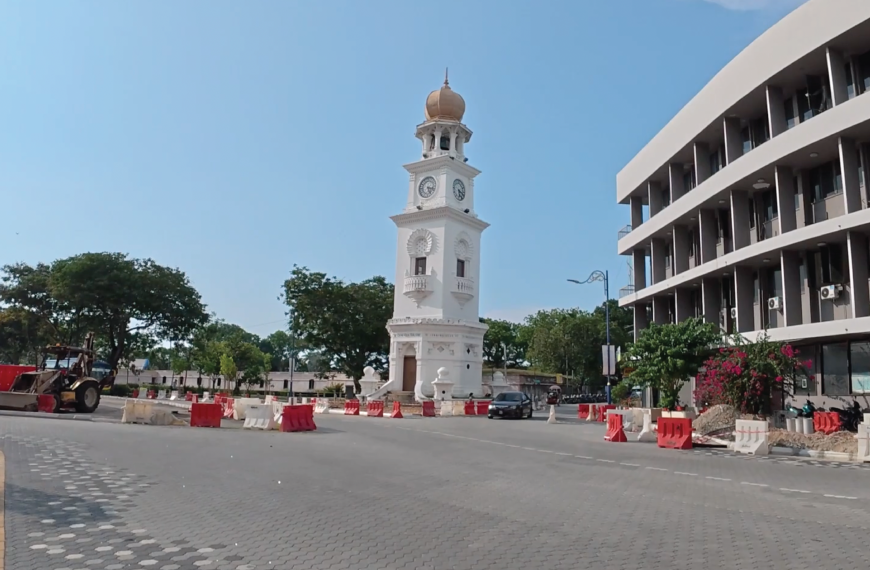
What is striking, looking at Georgetown in 2026, is how much of this original infrastructure remains visible and continues to function. The 1909 fire station still stands. Cheah Chen Eok clock tower, built in 1897 to mark Queen Victoria’s Diamond Jubilee, also stands. And the Eastern and Oriental Hotel, founded in 1885 by the Sarkies brothers, still operates as a working luxury hotel. Several clan houses (the Khoo Kongsi, the Cheah Kongsi, the Yap Kongsi, the Tan Kongsi) still function as working civic institutions of the Chinese community. So this is a town that the British colonial framework built, and that has retained its working civic character through the post-independence period in a way that, in my view, few other colonial urban projects have managed.
The Multicultural Population The British Brought Together
Penang’s population under the British was multicultural from the very beginning, and this is one of the most important parts of the story to understand honestly. Chinese settlers came in substantial numbers from Fujian and Guangdong, initially as merchants and traders, later as labourers in the broader regional economy. Tamils came from southern India, initially through the British East India Company’s labour and commercial networks. Anglo-Burmese came across from the British administration in Rangoon. Anglo-Indians came across from the British administration in Calcutta and Madras. Europeans came in smaller numbers as administrators, traders, plantation managers, and military personnel. And Malays were present in lesser numbers, given that the island had been sparsely populated before the British arrived.
So the multicultural population of Georgetown in the nineteenth century was a creation of the British commercial framework that brought these communities together under a single colonial administration. Importantly, this is not a criticism. It is the historical reality. The British framework, by establishing a free port and a stable commercial administration, created the conditions under which multiple Asian trading communities could converge on Penang and build a working multicultural civic life. Honestly, the multicultural Penang that gets celebrated as a triumph of Asian diversity in 2026 is, in functional terms, a British colonial achievement that the post-independence Malaysian government has had the good sense to preserve.
The Straits Settlements Framework
In 1826, Penang joined with Malacca and Singapore to form the Straits Settlements, the British colonial administrative unit that would shape the broader peninsula for the next century. Specifically, the Straits Settlements provided a unified administrative framework across the three port cities, with shared legal infrastructure, shared commercial regulation, and a shared political administration that operated under direct British East India Company rule, and from 1867 under direct British Crown rule.
This is the part of the story that explains why Penang, Malacca, and Singapore all retain a similar institutional texture to this day. The British administrative framework that bound the three together for over a century left a deep mark on the legal systems, the civic institutions, the urban planning approaches, and the broader cultural framework of the three cities. Honestly, the long-term Western foreigner who walks through Georgetown, Malacca, and Singapore in 2026 is walking through three cities that share an institutional heritage that the British colonial framework created.
How The British Framework Survived Independence
Malaysia became independent in 1957, and the question of what would happen to the British institutional inheritance was one of the central political questions of the post-independence period. Different post-colonial countries handled this differently. Burma, as I have written about in detail, disavowed the British framework comprehensively and is poorer for it. Singapore, as I have also written about, kept the framework and ran with it. Malaysia, including Penang, occupied a middle position, retaining substantial parts of the British framework while developing its own post-independence political and cultural identity.
What is striking about Penang specifically is how much of the British framework the island has retained, the history of Penang is alive in that sense. The legal system remains broadly inherited from the British colonial framework. Civic architecture remains intact in the Georgetown UNESCO zone. And the commercial framework remains functional in a way that traces directly back to the free port decision Francis Light made in 1786. So Penang, in my view, is one of the great examples of a post-colonial city that has had the institutional confidence to retain what worked from the colonial period without performing the disavowal that other post-colonial countries have performed.
The UNESCO World Heritage Listing In 2008
The UNESCO World Heritage Centre recognised the history of Penang and listed Georgetown as a World Heritage Site in 2008, alongside Malacca, under the joint designation of the Historic Cities of the Straits of Malacca. Specifically, the listing recognised the outstanding universal value of the colonial-era civic architecture, the multicultural commercial framework, the clan houses, the religious buildings, and the broader urban fabric that the British and the subsequent Malaysian administrations had preserved.
The UNESCO listing is, in my view, the international acknowledgement that what Penang represents is genuinely valuable. So this is not just a pleasant Asian island with good food. It is a working historical monument to a particular kind of colonial commercial framework that produced something that the international heritage community has decided deserves preservation. Honestly, the long-term Western foreigner who walks through the UNESCO zone in 2026 is walking through a working preserved example of the British colonial commercial city, and the preservation is one of the things that makes Penang worth taking seriously as a long-term destination.
What The British Framework Specifically Built
Now I want to be specific about what the British framework actually built in Penang, part of the history of Penang, because most of what gets written tends to skip over the specifics in favour of generic statements about multiculturalism.
Specifically, the British built the legal system. Penang’s commercial and civil law remains broadly inherited from the British colonial framework, with the Malaysian post-independence adaptations layered on top. They built the civic administration. Municipal structure of Georgetown, the property registration framework, and the commercial licensing framework all trace back to the British colonial period. Crucially, they built the educational infrastructure too. Penang Free School, founded in 1816, is the oldest English-medium school in Southeast Asia, and it continues to operate in 2026 as one of the most respected educational institutions in Malaysia. Finally, they built the medical infrastructure. The British colonial administration founded Penang General Hospital and remains the public hospital of reference for the island.
So these are not abstract achievements. Rather, these are concrete institutions that the British colonial framework built and that continue to function in 2026 as the foundation of what makes Penang work as a city. Honestly, the long-term Western foreigner who benefits from the legal system, the civic administration, the educational infrastructure, and the medical framework of Penang is benefiting from the British colonial inheritance whether he chooses to acknowledge it or not.
The Penang Of 2026 Is The British Framework Still Functioning
I want to make this point clearly because I think it is the most important thing the article needs to land. The Penang of 2026, with its hawker food, its colonial architecture, its multicultural commercial population, its functioning civic institutions, its UNESCO World Heritage zone, its English-medium educational tradition, its private hospitals (Penang Adventist, Gleneagles Penang, Island Hospital), is the British colonial framework still functioning two and a half centuries after Francis Light arrived, the history of Penang is alive on that front. So the framework has been adapted, modified, and developed by the post-independence Malaysian administrations, but the underlying institutional structure that makes the island work is the British inheritance.
Honestly, this is not a controversial historical claim. It is the historical record. The British built Georgetown. They built the institutional framework. They brought together the multicultural commercial population through the free port decision. The Malaysian post-independence administrations have retained and developed the inheritance, and the result is the working Penang of 2026 whose origins almost nobody is willing to engage with honestly.
Why The History of Penang Matters to the Long Term Foreigner
I want to be clear about why this matters for the long-term Western foreigner who is considering Penang as a destination, because the history of Penang is not just an academic point. It has practical implications.
Specifically, the long-term Western foreigner who chooses Penang is choosing a city whose institutional framework was built by the British and has been preserved by the Malaysians. A legal system is familiar in its broad architecture. English-medium educational infrastructure is genuinely functional. Civic administration operates on principles that the Western foreigner recognises. By contrast, the food scene is multicultural in a way that the British free port decision created. The private hospitals operate on international standards. The broader institutional confidence of the island is rooted in the colonial commercial framework that produced it.
Honestly, this is the part of the Penang story that almost nobody is willing to engage with. Writers celebrate the multicultural Penang of 2026 without acknowledging that the multiculturalism was a British colonial achievement. They celebrate the functional civic infrastructure without acknowledging that the infrastructure was a British colonial creation. They celebrate the institutional confidence of the island without acknowledging that the confidence is rooted in the colonial inheritance. The honest reading is that Penang works because the British built it to work, and the Malaysians have had the good sense to retain what works.
How Penang Compares To Other Post-Colonial Cities
I want to put Penang in the broader Southeast Asian comparative context, because the comparison sharpens the argument I am making.
Specifically, Singapore retained the British framework comprehensively and built on it, and the result is the global financial centre of 2026 that I have written about in detail. By contrast, Burma disavowed the British framework comprehensively and is structurally poorer for it, as I have also written about. Penang occupies a middle position, retaining substantial parts of the framework while developing its own post-independence identity. The result is a city that is more institutionally functional than Burma, more culturally textured than Singapore, and that offers the long-term Western foreigner an option that, in my view, is one of the most genuinely attractive destinations in Southeast Asia in 2026.
By contrast, Bangkok has a different historical trajectory. Thailand was never colonised, and the city has its own institutional framework that has developed independently. The Thailand of 2026, as I have written about, is in a particular kind of trouble that the long-term Western foreigner needs to recognise. By contrast, Penang offers a stability and an institutional confidence that, in my view, is rooted in the British colonial framework that built it.
What The Long-Term Western Foreigner Should Take From The History
So what should the long-term Western foreigner take from the history of Penang in 2026?
In my view, three things. Firstly, the institutional framework of Penang is rooted in the British colonial inheritance, and the framework continues to function in ways that the long-term Western foreigner can engage with on familiar terms. Secondly, the multicultural texture of the island is a British colonial achievement that the Malaysians have preserved, and the result is one of the most genuinely interesting cultural environments in Southeast Asia. Thirdly, the UNESCO World Heritage listing is the international acknowledgement that what Penang represents is genuinely valuable, and the listing has helped preserve the civic infrastructure that the British built and that the Malaysians have maintained.
Honestly, these three things together are what make Penang one of the most attractive destinations in Southeast Asia for the long-term Western foreigner in 2026. The British framework that built the island remains the foundation of what makes it work, and the foreigner who acknowledges this honestly is the foreigner who is in the best position to engage with what the island actually offers.
The Honest Verdict On The History of Penang
So that is the honest verdict on the history of Penang. Originally, the island was a sparsely populated and minimally developed location before Francis Light arrived in 1786. A British colonial commercial framework that he and his successors established built Georgetown into one of the great trading cities of Southeast Asia. Multicultural commercial population that defines the island was a deliberate consequence of the free port decision. Civic infrastructure, the legal system, the educational framework, and the medical infrastructure all came from the British colonial administration. By contrast, the post-independence Malaysian administrations have had the good sense to retain and develop the inheritance rather than disavow it. The result is the working Penang of 2026 that gets celebrated by everyone without anyone engaging honestly with its origins.
Honestly, the history of Penang is fascinating because it is one of the great success stories of the British presence in Southeast Asia, and the success is visible to anyone who walks through Georgetown in 2026 with open eyes. The British built something that worked, the Malaysians preserved what worked, and the long-term Western foreigner who chooses Penang is choosing a city whose institutional framework can be traced directly back to the decisions Francis Light made in 1786. So that is the honest reading. That is what I think the long-term Western foreigner who is considering Penang needs to hear, and that is the version of the history that almost nobody else is willing to tell.
Frequently Asked Questions
When did the British arrive in Penang?
Specifically, the British first arrived in Penang in 1786 when Francis Light, a captain of the British East India Company, negotiated an agreement with the Sultan of Kedah to cede the island to the company. Light landed on the island in August 1786 and founded the settlement of Georgetown at the northeastern tip, renaming the island Prince of Wales Island in honour of King George III. The arrival marked the beginning of the British presence in what would become the broader Straits Settlements framework, and Penang was the first British territorial acquisition in Southeast Asia.
Why is Penang’s history considered fascinating?
Honestly, Penang’s history is fascinating because it represents one of the great success stories of British colonial commercial development in Southeast Asia. The island was sparsely populated and minimally developed before Francis Light arrived in 1786. Within a century, the British colonial framework had built Georgetown into one of the most important commercial centres in the region, with a multicultural commercial population that the free port decision attracted from across the Indian Ocean maritime network. Then, the institutional inheritance has been retained by the post-independence Malaysian administrations, and the result is a working preserved example of the British colonial commercial city that UNESCO listed as a World Heritage Site in 2008.
What did Francis Light do at Penang?
Specifically, Francis Light negotiated the cession of the island from the Sultan of Kedah, founded the settlement of Georgetown, declared Penang a free port with no import or export duties, and established the broader commercial framework that would attract the multicultural trading communities that defined the island for the next two centuries. By contrast with the heavily regulated Dutch ports across the Straits, Penang’s free port framework offered the Asian trading communities of the region a genuinely attractive commercial base. So the decision attracted Chinese merchants from Fujian and Guangdong, Tamil merchants from southern India, and the various other regional communities that built the multicultural Georgetown of today.
Who were the multicultural communities that the British attracted to Penang?
Specifically, the Chinese came in substantial numbers from Fujian and Guangdong, initially as merchants and traders, later as labourers in the broader regional economy. Tamils came from southern India, initially through the British East India Company’s labour and commercial networks. Anglo-Burmese came across from the British administration in Rangoon. Anglo-Indians came across from the British administration in Calcutta and Madras. Europeans came in smaller numbers as administrators, traders, plantation managers, and military personnel. So the multicultural population of Georgetown in the nineteenth century was a creation of the British commercial framework that brought these communities together under a single colonial administration, and the result is the multicultural Penang that everyone celebrates in 2026 without acknowledging the British origins.
What was the Straits Settlements framework?
In 1826, Penang joined with Malacca and Singapore to form the Straits Settlements, the British colonial administrative unit that would shape the broader peninsula for the next century. Specifically, the Straits Settlements provided a unified administrative framework across the three port cities, with shared legal infrastructure, shared commercial regulation, and a shared political administration that operated under direct British East India Company rule, and from 1867 under direct British Crown rule. This is the part of the story that explains why Penang, Malacca, and Singapore all retain a similar institutional texture to this day. Honestly, the long-term Western foreigner who walks through the three cities in 2026 is walking through cities that share an institutional heritage that the British colonial framework created.
Why did UNESCO list Georgetown as a World Heritage Site?
Specifically, UNESCO listed Georgetown as a World Heritage Site in 2008, alongside Malacca, under the joint designation of the Historic Cities of the Straits of Malacca. The listing recognised the outstanding universal value of the colonial-era civic architecture, the multicultural commercial framework, the clan houses, the religious buildings, and the broader urban fabric that the British and the subsequent Malaysian administrations had preserved. Honestly, the listing is the international acknowledgement that what Penang represents is genuinely valuable, and it has helped protect the civic infrastructure that defines the island.
How does Penang compare to Singapore and Burma in terms of British colonial inheritance?
Specifically, Singapore retained the British framework comprehensively and built on it, with the result that it has become the global financial centre of 2026. By contrast, Burma disavowed the framework comprehensively and is structurally poorer for it. Penang occupies a middle position, retaining substantial parts of the framework while developing its own post-independence identity. So the result is a city that is more institutionally functional than the post-disavowal Burma, more culturally textured than the high-net-worth-engineered Singapore, and that offers the long-term Western foreigner one of the most genuinely attractive destinations in Southeast Asia.
What did the British actually build in Penang?
Specifically, the British built the legal system, the civic administration, the educational infrastructure, and the medical infrastructure of the island. The Penang Free School, founded in 1816, is the oldest English-medium school in Southeast Asia and continues to operate as one of the most respected educational institutions in Malaysia. The British colonial administration founded Penang General Hospital and remains the public hospital of reference for the island. Specifically, the civic infrastructure of Georgetown (the courthouse, the customs house, the police station, the 1909 fire station, the Cheah Chen Eok clock tower built in 1897 for Queen Victoria’s Diamond Jubilee, the Eastern and Oriental Hotel founded in 1885) was all built under the British administration and continues to function in 2026. So these are concrete institutions that the British framework built and that continue to make the island work.
Why should the long-term Western foreigner care about this history?
Honestly, the long-term Western foreigner who is considering Penang is choosing a city whose institutional framework was built by the British and has been preserved by the Malaysians. A legal system is familiar in its broad architecture. English-medium educational infrastructure is genuinely functional. Civic administration operates on principles that the Western foreigner recognises. Food is multicultural in a way that the British free port decision created. And the broader institutional confidence of the island is rooted in the colonial commercial framework that produced it. So the long-term Western foreigner who acknowledges this honestly is the foreigner who is in the best position to engage with what the island actually offers, and the foreigner who refuses to acknowledge it is the foreigner who will misunderstand why Penang works the way it does.
What is the honest summary of the article’s argument?
Ultimately, the history of Penang is fascinating because it is one of the great success stories of the British presence in Southeast Asia. Francis Light arrived in 1786 to a sparsely populated and minimally developed island. The British colonial commercial framework that he and his successors established built Georgetown into one of the great trading cities of Southeast Asia, with a multicultural commercial population that the free port decision attracted. The civic infrastructure, the legal system, the educational framework, and the medical infrastructure were all built by the British colonial administration. By contrast, the post-independence Malaysian administrations have had the good sense to retain and develop the inheritance rather than disavow it.
Sources
- UNESCO World Heritage Centre Georgetown Penang Listing — the official 2008 World Heritage designation documentation of Georgetown alongside Malacca under the joint Historic Cities of the Straits of Malacca listing referenced as the core international acknowledgement of the article’s argument
https://whc.unesco.org/en/list/1223 - George Town World Heritage Incorporated — the official Penang state government body administering the UNESCO World Heritage zone including the conservation framework and the documentation of the colonial-era civic architecture referenced throughout the article
https://www.gtwhi.com.my/ - Wikipedia — Francis Light, the documentation of the British East India Company captain who arrived in 1786, negotiated the cession of Penang from the Sultan of Kedah, founded Georgetown, and declared the free port that built the multicultural commercial framework
https://en.wikipedia.org/wiki/Francis_Light - Wikipedia — History of Penang, the comprehensive documentation of the island’s trajectory from the 1786 British arrival through the Straits Settlements period to independence and the UNESCO listing referenced throughout the article
https://en.wikipedia.org/wiki/History_of_Penang - Wikipedia — George Town Penang, the documentation of the UNESCO-listed colonial-era city including the civic architecture, the clan houses, the religious buildings, and the broader heritage framework referenced in the article
https://en.wikipedia.org/wiki/George_Town,_Penang - Wikipedia — Straits Settlements, the documentation of the 1826 administrative unit joining Penang with Malacca and Singapore under British colonial administration including the 1867 transition to direct Crown rule referenced in the article
https://en.wikipedia.org/wiki/Straits_Settlements - Wikipedia — Demographics of Penang, the documentation of the multicultural population formation including the Chinese, Tamil, Anglo-Burmese, Anglo-Indian, European, and Malay community breakdown referenced in the article’s multicultural construction argument
https://en.wikipedia.org/wiki/Demographics_of_Penang - Penang Free School Official Documentation — the official documentation of the Penang Free School founded in 1816 referenced as the oldest English-medium school in Southeast Asia and one of the most respected educational institutions in Malaysia in 2026
https://www.penangfreeschool.edu.my/ - Penang State Government Tourism and Heritage Documentation — the official Penang state documentation of the historical and cultural framework including the Francis Light arrival and the broader colonial-era development referenced in the article
https://www.penang.gov.my/ - Eastern and Oriental Hotel Penang Heritage Documentation — the documentation of the E&O Hotel founded in 1885 by the Sarkies brothers referenced in the article’s civic architecture argument as still operating in 2026
https://www.eohotels.com/penang/ - Khoo Kongsi Clan House Penang — the documentation of the major Penang clan house referenced in the article as one of the working civic institutions of the Chinese community that still functions in 2026
https://www.khookongsi.com.my/ - Cheah Kongsi Penang — the documentation of the Cheah clan house referenced in the article’s list of working clan house institutions in Georgetown
https://www.cheahkongsi.com.my/ - Wikipedia — Penang Free School, the documentation of the 1816-founded English-medium institution and the broader Penang educational framework that traces back to the British colonial administration
https://en.wikipedia.org/wiki/Penang_Free_School - Wikipedia — Eastern and Oriental Hotel, the documentation of the 1885 Sarkies brothers hotel that has operated continuously since the British colonial period and is referenced in the article’s surviving civic architecture argument
https://en.wikipedia.org/wiki/Eastern_%26_Oriental_Hotel - Penang Heritage Trust — the documentation of the non-governmental heritage organisation that has documented and advocated for the preservation of the Georgetown colonial-era architecture referenced throughout the article
http://www.pht.org.my/ - British Library India Office Records on Penang and the Straits Settlements — the official British archive documentation of the East India Company’s administration of Penang from 1786 and the broader Straits Settlements framework referenced in the article
https://www.bl.uk/collection-guides/india-office-records - National Archives of Malaysia Penang Records — the official Malaysian archive documentation of Penang’s colonial and post-independence administrative history referenced in the article’s broader institutional argument
https://www.arkib.gov.my/ - Wikipedia — Cheah Chen Eok, the documentation of the Penang community leader who funded the 1897 clock tower in Georgetown built to commemorate Queen Victoria’s Diamond Jubilee referenced in the article’s civic architecture argument
https://en.wikipedia.org/wiki/Cheah_Chen_Eok