The Sa Kaeo Kidnapping Case Explained
On the 16th of May, 2026, five Chinese nationals were sitting in an isolated house in a forested area of Wang Somboon district, in Sa Kaeo province, close to the Cambodian border. Their hands were tied behind their backs. They had been there since around 2 in the morning. The men holding them were police officers, in police uniform, with police authority, who had pulled their vehicle over earlier that night on the pretext that they had entered Thailand illegally. Instead of being taken to a police station for legal processing, the way any normal country handles a suspected immigration violation, the five had been driven into the forest and told they would be released if each of them paid ten thousand US dollars. Three hundred thousand Thai baht per head. Half a million dollars across the group. Two of them paid two thousand each before the rescue arrived, because they did what anyone tied up in a forest would do when the people holding them have guns and uniforms. They paid what they could.
The rescue arrived because one of the victims had a phone with the LINE app, and managed to message an immigration officer in another province asking for help. The immigration office in Sa Kaeo organised a raid. The five Chinese nationals were found outside the house. Police arrested four officers on the scene, identified as Police Senior Sergeant Majors Paphawin, Wuttikorn, Phichate, and Somchai, along with a civilian named Nattanan. A fifth officer surrendered later. A sixth remains at large. The officers eventually admitted to what they had done. They are charged with unlawful detention and abuse of authority. The maximum penalty is twenty years.
This Is Not A Movie. This Is Documented Fact.
This is not a movie. This is not a rumour. This is not what one Thailand YouTuber called nonsense in his last video. This is what the Bangkok Post, the Thaiger, Channel 7, the Chiang Rai Times, the Thai Examiner, the Nation, and the Chinese embassy in Bangkok have all formally documented, and it happened two weeks ago. The five victims were Chinese tourists, in a country that has spent the last fifteen years building its entire tourism strategy around Chinese arrivals, kidnapped by the actual police force of the actual Thai state, for ransom, in a forest, two hundred kilometres from the capital city. This is the country lecturing foreigners about respect. This is the country telling you that you have nothing to fear if you have done nothing wrong. This is the country whose Tourism Minister is currently talking about screening foreign arrivals for quality. And six of its police officers were tying tourists to chairs in a forest demanding ten thousand dollars each, in the same month that conversation was happening in public.
This article is about what that case tells you, and what every foreigner currently in Thailand or thinking about going to Thailand needs to actually understand about it. Because the headline is shocking on its own. The deeper story is worse.
These Were Real Serving Thai Police Officers
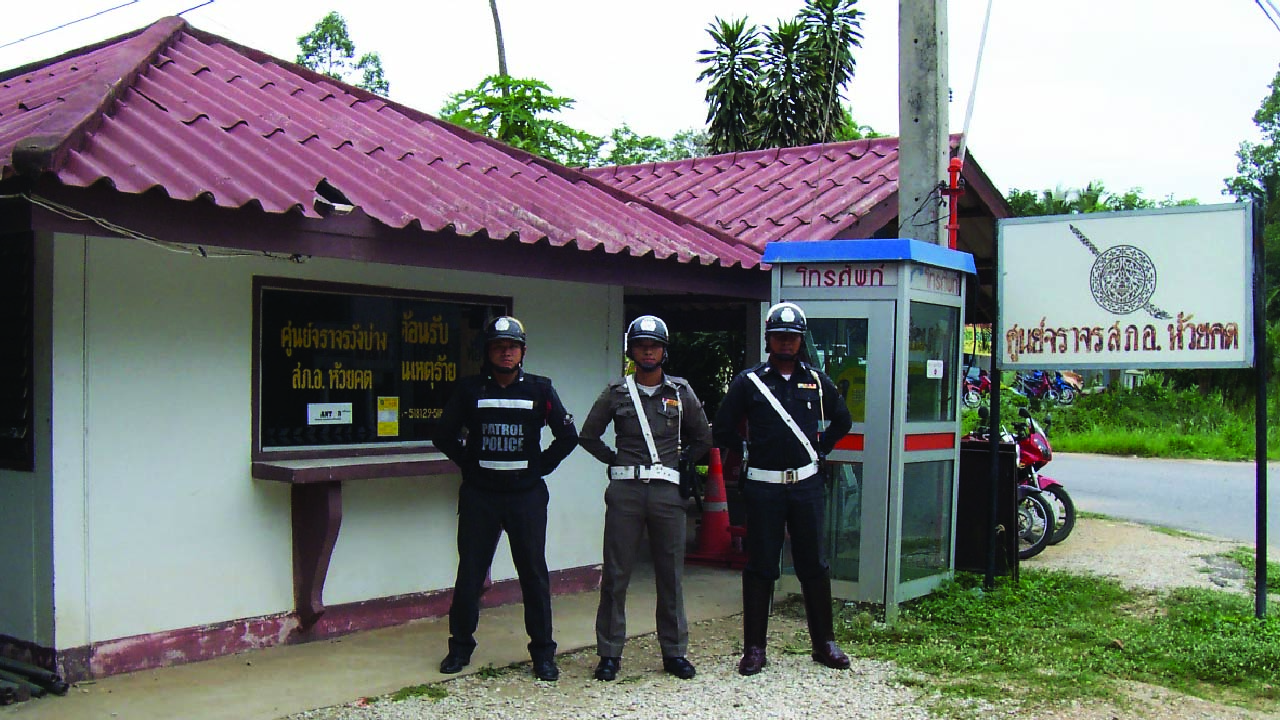
Start with what these men were. Not impersonators. Not gangsters dressed up. Actual serving Thai police officers, in real uniform, using real police authority, driving real police vehicles, working from a real police station in Wang Somboon. The reason they were able to pull over a vehicle on a Thai road at 2 in the morning is that they had the legal power to do so. The reason they were able to take five people to a private house in a forest instead of a police station is that no other officer or institution at that point in the night had any way of knowing that was where they were going. The reason the case only came to light is that one of the victims happened to have a phone and the language ability to use it. Take the phone away. Take the working internet connection away. Take away the immigration officer in another province willing to take a panicked LINE message from a tourist she had never met. None of that happens and those five people pay three hundred thousand baht each, get released back into Thailand, and either fly home in silence or never get released at all. We do not know what was supposed to happen if they could not pay.
How Many Other Cases Have There Been That Did Not Make The News
Now stop and think about this. The Sa Kaeo case only made the news because the system failed in the favour of the victims. The phone worked. The immigration officer answered. The raid was organised quickly enough that the victims were found alive. Strip away any one of those coincidences and there is no case, no arrests, no Chinese embassy statement, no national scandal. There is just five Chinese tourists who got into some kind of trouble at the border and were never heard from again, and a group of police officers who pocketed half a million dollars and went home to their families.
Now ask the obvious question. How many other cases were there. How many other foreigners, less lucky, less connected, less able to use a Thai messaging app at 11 in the morning under guard, simply paid the money and went home in silence. The cases that make the news are the cases where something went wrong with the operation. Every smooth operation, every successful extortion that ends with the victim paying and leaving the country, never enters the public record at all. The Sa Kaeo case is the visible part of a structure. The invisible part of the structure is where most of these cases live.
The Pattern Is Documented And Goes Back Years
The pattern is documented. This is not the first time. In July 2025, a 52-year-old Chinese tourist named Lin Yifan was abducted from a noodle stand on North Pattaya Road by men shouting “I am police, you are call centre,” forced into a white SUV, threatened, and robbed of 230,000 baht across cash and a banking app transfer. The men were eventually found to be impersonators rather than serving officers, but the question this raises is the wrong way round. The question is not why criminals are impersonating Thai police. The question is why impersonating a Thai police officer is, in 2026, a working strategy for extorting foreigners. The answer is that the real ones do it openly enough that the fake ones blend in. There have been Pattaya cases involving transwomen running set-up extortion operations against Chinese tourists. There have been Pattaya weapons cache cases where Thai navy officers and Bangkok police officers were caught selling firearms to Chinese nationals. There have been scam compound corruption cases that The Irrawaddy has been documenting for two years, in which Thai officials are paid by the cross-border syndicates whose victims are then trafficked through Thai provinces. The Sa Kaeo case is the most viral and best documented example of a pattern that has been visible to anyone paying attention.
The Hypocrisy Of The Thai Anti-Foreigner Campaign In May 2026
Look at the timing of it. Look at the country it is happening in. Thailand, May 2026, is in the middle of the loudest anti-foreigner enforcement campaign of any country in Asia. The 60-day visa-free programme has just been cancelled for 93 countries. The Indian visa-free programme has been removed entirely. The Koh Phangan nominee crackdown has arrested 22 foreigners and seized 200 million baht of property in two phases over ten days, and the official figure released by the Thai government is that 68 per cent of firms with foreign ownership links on the island use nominee structures, meaning the country has just publicly admitted that two thirds of its foreign business sector operates outside the law. The Tourism Minister is talking about screening tourist arrivals for quality. The Bureau of Immigration is staging weekly press conferences about foreigners abusing Thai hospitality. The Prime Minister is in Paris briefing the French President on Thai national priorities. And while every microphone in the country is pointed at how foreigners are letting Thailand down, six of Thailand’s own police officers were operating a kidnap-for-ransom ring against tourists in a forest on the Cambodian border.
The hypocrisy is not subtle. The hypocrisy is not even being hidden. The hypocrisy is the public position of the Thai state running directly against the documented private behaviour of its own institutions, in the same week, in the same news cycle, with no Thai official willing to acknowledge that the contradiction exists.
The China Problem Thailand Cannot Wave Away
Then there is the China problem, which is the part of this that the Thai government cannot easily wave away. Thailand, for the last fifteen years, has been quietly pivoting its foreign tourism strategy away from the West and toward China. The Belt and Road infrastructure deals. The Chinese tour group operators bussing visitors into Bangkok and Pattaya in industrial volume. The Chinese-funded condominium developments along the Sukhumvit corridor. The Thai-Chinese high-speed rail to Kunming. The studied silence on the West Philippine Sea question to keep Beijing happy. The deportation of 109 Uyghur refugees in February 2025 specifically to please the Chinese state. The country has bent over backwards to court the Chinese market because the Chinese market is its largest tourist source, with 2.16 million arrivals through May 17 of this year alone.
And what has Thailand done with that strategy. It has allowed its own police to kidnap Chinese tourists for ransom in a border province. It has allowed Chinese tourists to be impersonated-police-kidnapped on the streets of Pattaya. It has allowed Chinese tourists to be set up in extortion stings by Thai sex workers operating with the apparent tolerance of local police. And in the same month the Sa Kaeo case broke, a Chinese arms dealer was arrested under armed guard at a Pattaya hospital for involvement with C4 explosives and assault rifles, and the Prime Minister had to publicly signal a review of Chinese visa policy because the situation has become unsustainable.
The Chinese Embassy Response And The Tourism Industry Backlash
The Chinese embassy in Bangkok has now formally demanded, in writing, that Thai authorities conduct a fair and transparent investigation of the Sa Kaeo case. The Association of Thai Travel Agents has warned that Chinese tourist bookings are slowing for the coming months. The Association of Chonburi Tourism Federation has warned that Chinese arrivals could fall by another 20 to 30 per cent on top of the 34 per cent collapse Thailand suffered last year. Chinese social media has been discussing the case for two weeks. The country that chose to throw the West over and bet on China is now publicly humiliating its chosen patron, by having its own police force kidnap Chinese citizens for ten thousand dollars each in a forest on the Cambodian border.
You could not write a better illustration of the failure of the Thai state’s foreign-tourism strategy if you tried. They invited the Chinese in. They put down the welcome carpet. They closed the door to Western tourists by making the country expensive, hostile, and bureaucratically nightmarish. And now their own police force is making the country dangerous, openly criminal, and physically unsafe for the demographic they bet the entire industry on.
What This Means For Every Foreigner In Thailand
Now bring it home for the foreigner reading this article, because this is where the structural lesson lives. The police in Thailand are not the police in your country. The Western foreigner, the Indian foreigner, the Korean foreigner, the Filipino foreigner, the Singaporean foreigner, everyone, has to understand this. The uniform you see in front of you in a tourist area, on a road, at a checkpoint, at the airport, is the same uniform that, in Sa Kaeo on the morning of May 16, was holding five tourists hostage in a forest. The institution is the same institution. The legal protections you assume exist between you and a uniformed officer of the Thai state are nowhere near what your home country trained you to expect. The standard Western assumption that the police are a professional service institution working within accountable structures does not apply in Thailand and has not applied for as long as there has been a modern Thai state.
What does apply is that, if a Thai police officer decides he wants what is in your wallet, the institutional infrastructure protecting you is thin, fragile, and dependent on luck. Your safety in Thailand is not contingent on you having done nothing wrong. Your safety in Thailand is contingent on the individual police officer you happen to encounter not deciding, on that particular day, that you are an opportunity. That is not a normal relationship to have with the institution of policing. That is the relationship people have with policing in failed states, in narco-states, in the worst kinds of border provinces in the worst kinds of countries on earth. Thailand markets itself as a sophisticated middle-income tourist destination. The Sa Kaeo case is what that marketing is concealing.
The Five Victims Were Rescued By Coincidence Not By The System
And one final point, because it has to be said. The five Chinese nationals were rescued because the Sa Kaeo Provincial Immigration Office responded to their LINE message. That is the only reason they are alive. That is the only reason they are not, today, statistics in the quiet column of foreigners who came to Thailand and never came home. The institution that saved them was not the police, who were the perpetrators. It was a different arm of the same state, acting by coincidence, in time, with enough independence from the men in uniform to take the call. The next group of foreigners may not be that lucky. The arm of the state that should have protected them was the one extorting them.
Remember What Was Happening In Sa Kaeo On May 16
So when the next Thai minister stands at a podium telling foreigners that Thailand does not tolerate misconduct, that foreigners need to respect Thai laws, that visitors should not expect the country to bend its rules for them, you should remember what was happening in Sa Kaeo province in the early hours of May 16. The police of Thailand were the misconduct. The police of Thailand were not respecting Thai laws. The police of Thailand were bending Thai law to a ten-thousand-dollar price tag, per head, in a forest house on the Cambodian border. And the only reason you know about it is that one of the victims had a phone, and one immigration officer two provinces away was willing to take the call.
Everything else, every cleaner operation, every successful extortion, every quiet payment, every foreigner who flew home and never said a word, lives in the part of the structure that does not appear in any news cycle. The Sa Kaeo case is the visible tip. The invisible structure underneath is what should make every foreigner reading this think very, very carefully about what kind of country they are choosing to put themselves in.
Frequently Asked Questions
What happened in the Sa Kaeo police kidnapping case in May 2026?
On 16 May 2026, five Chinese nationals were stopped on a Thai road around 2 am by serving Thai police officers in Sa Kaeo province near the Cambodian border. Instead of being taken to a police station for the immigration violation the officers cited, the five were driven to an isolated house in a forested area of Wang Somboon district, tied up, and told they would each have to pay ten thousand US dollars (three hundred thousand baht) for their release. Two paid two thousand each before a rescue arrived. One victim used the LINE messaging app to alert an immigration officer in another province, who organised a raid. Four officers were arrested at the scene, a fifth surrendered later, a sixth remains at large.
Were the kidnappers real Thai police officers or impersonators?
Real Thai police officers. They were in police uniform, driving police vehicles, using police authority, and working from a real police station in Wang Somboon. The four officers arrested at the scene have been identified as Police Senior Sergeant Majors Paphawin, Wuttikorn, Phichate, and Somchai. The officers have admitted what they did and face charges of unlawful detention and abuse of authority carrying a maximum penalty of twenty years.
Has this kind of police kidnapping happened in Thailand before?
Yes. The pattern is documented. In July 2025, a 52-year-old Chinese tourist named Lin Yifan was abducted from a noodle stand on North Pattaya Road by men shouting “I am police, you are call centre,” forced into a white SUV, and robbed of 230,000 baht across cash and banking app transfers. Those men were impersonators rather than serving officers, but the very fact that impersonating Thai police is a working extortion strategy tells you the real ones operate openly enough that the fake ones blend in. Other documented cases include Pattaya extortion set-ups, Thai navy officers selling firearms to Chinese nationals, and scam compound corruption that The Irrawaddy has been documenting for two years.
Why is the Sa Kaeo case particularly damaging for Thailand’s tourism strategy?
Because Thailand has spent the last fifteen years pivoting its tourism strategy away from Western markets and toward Chinese arrivals. China is now Thailand’s largest tourist source with 2.16 million arrivals through May 17 2026. The Chinese embassy in Bangkok has formally demanded a fair and transparent investigation. The Association of Thai Travel Agents has warned of slowing Chinese bookings. The Chonburi Tourism Federation has warned of Chinese arrivals falling another 20 to 30 per cent on top of the 34 per cent collapse Thailand suffered last year. The country that chose to bet on China for its tourism economy is now publicly humiliating that strategy through its own police force.
What should foreigners in Thailand understand about Thai police?
The police in Thailand are not the police in any Western country. The institutional infrastructure protecting a foreigner from misconduct by a uniformed officer is thin, fragile, and dependent on luck. Safety in Thailand is not contingent on the foreigner having done nothing wrong. Safety is contingent on the individual officer encountered not deciding, on that particular day, that the foreigner is an opportunity. That is the relationship to policing that exists in failed states, narco-states, and the worst kinds of border provinces, not in countries that market themselves as sophisticated middle-income tourist destinations.
How many similar cases are there that have not made the news?
Unknown. The Sa Kaeo case only became public because every link in the rescue chain happened to work. A working phone with the LINE app. A victim with the language ability to use it. An immigration officer in another province willing to take the call from a stranger. A raid organised quickly enough to find the victims alive. Strip any one of those coincidences out and the case never enters the public record. Every smooth operation, every successful extortion that ends with the victim paying and leaving the country in silence, never makes the news. The Sa Kaeo case is the visible tip of a much larger structure.
Sources
- Bangkok Post — Four police officers and a civilian arrested in Sa Kaeo for kidnapping five Chinese nationals and demanding 300,000 baht ($10,000) from each, Wang Somboon district, isolated house in forested area of tambon Wang Mai, May 16, 2026
https://www.bangkokpost.com/thailand/general/3257084/4-police-held-in-chinese-kidnapextortion-case - The Thaiger — Five police officers and a civilian arrested in Sa Kaeo extortion case, victims contacted Sa Kaeo Provincial Immigration Office via LINE app, officers identified as Police Senior Sergeant Majors Paphawin, Wuttikorn, Somchai, and Phichate, plus civilian Nattanan
https://thethaiger.com/news/national/5-sa-kaeo-police-arrested-for-allegedly-extorting-chinese-nationals - The Thaiger — Sixth police officer surrendered in the Sa Kaeo Chinese extortion case, charges include unlawful detention and abuse of authority, maximum penalties of up to 20 years in prison and fines of up to 400,000 baht, Channel 7 reported confessions after initial denials
https://thethaiger.com/news/national/another-police-officer-involved-in-chinese-extortion-case-in-sa-kaeo-surrenders - Chiang Rai Times — Detailed account of the Sa Kaeo rescue, two victims paid $2,000 each before rescue ($4,000 / 120,000 baht successfully extorted), LINE message sent at 11am to immigration officer in another province, raid at approximately 7:30pm on May 16, 2026, Pol Maj Gen Thaworn Dunwit identified as Sa Kaeo Provincial Police Commander
https://www.chiangraitimes.com/hot-news/crime/police-officers-arrested-sa-kaeo/ - The Thaiger — Chinese Embassy in Bangkok formally demands fair and transparent investigation of the Sa Kaeo extortion case, May 19, 2026 statement urging Thai police to verify facts and bring all offenders to justice
https://thethaiger.com/news/national/chinese-embassy-sa-kaeo-extortion-case - Thai Examiner — Widening Sa Kaeo police extortion scandal damaging Chinese tourist market, six cops charged, security warnings from Beijing, slowing Chinese bookings, suspected cross-border scam syndicate links being investigated through cryptocurrency transfers and CCTV evidence
https://www.thaiexaminer.com/thai-news-foreigners/2026/05/25/widening-sa-kaeo-police-extortion-scandal-has-already-badly-damaged-chinese-tourist-market-for-thailand/ - Bangkok Post — Extortion scandal hits Chinese bookings, Association of Thai Travel Agents (Atta) warning, Chinese tourists losing confidence in travel to Thailand, Atta honorary secretary-general Adith Chairattananon on viral Chinese social media coverage
https://www.bangkokpost.com/business/general/3260378/extortion-scandal-hits-chinese-bookings - Tourism Authority of Thailand — China is Thailand’s largest tourist market with 2.16 million arrivals through May 17, 2026, representing 18.8% year-on-year increase; last year’s total arrivals from China stood at 4.47 million after the 34% collapse
https://www.tat.or.th/en/about-tat/statistics - Nation Thailand — Association of Chonburi Tourism Federation warning of potential further 20 to 30 per cent fall in Chinese arrivals on top of last year’s already collapsed numbers, president Thanet Supornsahasrungsi on Pattaya tourism impact
https://www.nationthailand.com/business/tourism/40063478 - Bangkok Post — Chinese tourist Lin Yifan abducted by men posing as police in Pattaya on July 10, 2025, 230,000 baht stolen across cash and banking app transfer, “I am police, you are call centre” pattern, white SUV abduction from North Pattaya Road noodle restaurant
https://www.bangkokpost.com/thailand/general/3067453/tourist-in-pattaya-robbed-of-b230-000-by-fake-police - Khaosod English — Chinese tourist assaulted and robbed of 20,000 baht by three transgender women at a Pattaya hotel on February 17, 2026, Soi 4 Pattaya Second Road, Nong Prue subdistrict, Bang Lamung district, Chonburi province
https://www.khaosodenglish.com/news/2026/02/17/chinese-tourist-assaulted-robbed-of-20000-baht-in-pattaya-hotel/ - Bangkok Post — Pattaya weapons cache investigation, Thai navy officers and Bangkok police officers charged with selling firearms to Chinese national, foreign criminality framing exposed as involving Thai state actors
https://www.bangkokpost.com/thailand/general/2849336/pattaya-weapons-thai-navy-officers - The Irrawaddy — Thai cabinet figures linked to scam compound networks operating along Thai-Burmese border, investigative reporting on cross-border syndicates and Thai official involvement in cyberfraud corruption
https://www.irrawaddy.com/news/burma/thai-cabinet-scam-compound-cyberfraud-border - Thai Examiner — Prime Minister signals review of Chinese visa policy after latest criminal case in Pattaya linked to arms, Chinese arms dealer arrested under armed guard at Pattaya hospital, C4 explosives and assault rifles, May 2026
https://www.thaiexaminer.com/thai-news-foreigners/2026/05/12/prime-minister-signals-review-of-chinese-visa-policy/ - CNN — Thailand cancels 60-day visa-free programme for over 90 countries, Cabinet decision May 19, 2026, Tourism and Sports Minister Surasak Phancharoenworakul announcement, reversion to previous 30-day visa regulations
https://www.cnn.com/2026/05/20/travel/thailand-visa-free-cut-intl-hnk - Bangkok Post — Koh Phangan nominee crackdown nets 22 foreigners, second phase of operation, more than 40 rai of land worth over 200 million baht seized, 37 cases pursued, 27 searches, 45 arrest warrants, Pol Gen Samran Nualma overseeing national crackdown, May 23, 2026
https://www.bangkokpost.com/thailand/general/3259705/koh-phangan-nominee-crackdown-nets-22-foreigners - Thai Examiner — Anutin visits Koh Phangan as nominee crackdown shows 68% of firms with foreign ownership links use nominee structures, May 14, 2026, official Thai government figure released during second phase of operation
https://www.thaiexaminer.com/thai-news-foreigners/2026/05/14/anutin-visits-koh-phangan-nominee-crackdown/ - Thai Examiner — Tourism Minister talks of limiting tourist arrivals with screening for quality visitors, Thailand launches sweeping tourism reform, May 11, 2026 statements on “quality visitor” framing
https://www.thaiexaminer.com/thai-news-foreigners/2026/05/11/tourism-minister-quality-visitors-screening/ - Reuters — Thailand-China Belt and Road infrastructure framework, high-speed rail connecting Bangkok to Kunming, strategic alignment between Bangkok and Beijing on regional infrastructure projects
https://www.reuters.com/world/asia-pacific/thailand-china-high-speed-rail-belt-road - Human Rights Watch — Thailand deports 109 Uyghurs to China in February 2025 despite credible international warnings of torture and arbitrary detention, violation of Article 3 of Convention Against Torture, demonstration of Bangkok’s strategic prioritisation of Beijing relations over international human rights obligations
https://www.hrw.org/news/2025/02/27/thailand-deports-uyghurs-china