The Line The Thai Establishment Keeps Repeating
Every defence of Thailand against foreign criticism, every lecture from a Thai minister, every blog post by a screaming Thailand apologist, every Bangkok lawyer telling foreigners to be grateful and quiet, eventually circles back to the same line. Thailand does not need foreign influence. Foreigners coming in with opinions are arrogant guests overstepping their place. The country has its own ways, its own culture, its own destiny, and the West can keep its lectures, its democracy, its human rights complaints, and its endless commentary to itself.
The argument is repeated so often that nobody in Thailand seems to have noticed how completely it falls apart the moment you actually look at what foreign influence means in the country making it.
They Are Not Refusing Foreign Influence. Only One Specific Kind.
Because the people repeating that line are not refusing foreign influence. They are refusing one specific kind of it. The kind that comes with criticism attached. The kind that asks the country to be accountable for what it is doing. The kind that points out the visa rules are arbitrary, the courts are captured, the corruption is endemic, the establishment is hostile to the foreigners who pay the bills. That kind of foreign influence is unwelcome. Every other kind, the kind that comes with no questions attached, the kind that fills their houses, fuels their cars, equips their hospitals, arms their military, educates their children, banks their fortunes, and props up the lifestyle of every politician who stands at a podium dismissing the West, is not just welcome. It is the entire foundation of modern Thai life. And the Thai establishment has spent fifty years understanding that, while telling everyone else something different.
This article is about that gap. What “foreign influence” actually means when you stop letting the people running Thailand define it for you. What Thailand would actually look like if foreign influence really were stripped out. Why Western governments have allowed this two-faced arrangement to continue for so long. Why Thailand has been busy throwing the West over for China the moment it could. And why the foreigner who defends Thailand against every criticism is not buying himself anything at all by doing so.
The Prime Minister Has Nothing Without Foreign Influence
Start with the prime minister, because I have already covered him in another article so this can be quick. Anutin Charnvirakul, the man who called Westerners dirty in 2020, has a Western education from Hofstra University in New York. Three private jets, none of them built in Thailand. A watch collection in the dozens, almost all of them Swiss. A net worth measured in the billions of baht, accumulated through a family construction empire that spent decades building infrastructure designed by foreign engineers and bid out under foreign-influenced procurement frameworks. Strip foreign influence out of his life and the man telling you that you do not belong in his country has nothing. No degree. No fortune. No aircraft. No watches. No Rolls-Royce. He would have to forgo the lifestyle and get back on the buffalo. That image is the right one for the entire Thai elite that hides behind the anti-foreign line. The buffalo is what waits for them at the bottom of the structure foreign influence built.
What A Bangkok Apartment Actually Contains
Now do the same exercise for Bangkok itself, because this is where the argument really collapses.
Walk through a Bangkok middle-class apartment and try to find a single object in it that exists because of purely Thai influence. The air conditioning was invented in America. The refrigerator in Germany. The television in Britain. The washing machine and the microwave in America. The electric kettle in Britain. The light bulb in America, the LED in America and Japan. The wiring, the voltage system, the plug pattern, the entire concept of mains electricity running safely through a house, all worked out in Britain, America, and Germany over a hundred years ago. The bathroom ceramics descend from the British flushing toilet. The shower, in its modern form, was invented in Britain. The smartphones, the laptops, the headphones, all invented in America. The Wi-Fi runs on protocols developed in Australia and America. The internet itself is British. Social media is American. The very platforms the Thai establishment uses to broadcast its anti-Western complaints are Western inventions, running on Western infrastructure, built by Western companies.
What Bangkok’s Streets, Trains, And Airports Actually Run On
Step outside. The car in the parking space exists because Karl Benz invented the automobile in Germany in 1885. The motorcycle came from the same country in the same year. The traffic light was invented in America in 1914. The Skytrain runs on technology developed in Britain and America. The MRT below it descends from the London Underground of 1863. Suvarnabhumi Airport exists because the Wright Brothers invented the aeroplane in 1903, the jet engine was invented in Britain and Germany, the radar in Britain, the X-ray scanner at security in Germany. The aircraft taking off from it are Boeing or Airbus.
Thai Hospitals Run On Western Medicine From Front To Back
Go to the hospital. Bumrungrad and Bangkok Hospital, the two flagship private hospitals Thailand uses to market itself as a medical tourism destination, run on Western discovery from front to back. The MRI, the CT scanner, the X-ray, modern anaesthesia, antibiotics, every major drug class in the pharmacy, all foreign. The doctors are Thai. The medicine they practise is Western. Even the paracetamol was discovered in a German laboratory.
The Thai Military Fights With Western Weapons
Go to the military. The fighter jet, the tank, the modern warship, the small arms the Thai infantry carries, the surveillance drones that watched the Cambodian border, all developed in Britain, Germany, America, Belgium and Austria. When the Royal Thai Army went to the Cambodian border in 2025 because they decided they wanted to steal Cambodian land, it went there using Western military science from front to back. The nationalism was Thai. Everything that did the fighting was someone else’s invention.
The Thai Police Use Western Technology To Harass Westerners
Now look at the police. The same force used to harass foreigners over TM30 paperwork drives patrol cars because Karl Benz invented the automobile. It carries sidearms based on Western designs. It runs surveillance cameras because CCTV was developed in Britain, and identification databases on software invented in America. The technology Thailand uses to police the very foreigners it claims it does not need came directly out of those foreigners’ own civilisations.
This is the country that says it does not need foreign influence. This is what the modern version of it actually looks like when you bother to actually say it like it is.
What Bangkok Would Look Like If You Stripped Foreign Influence Out
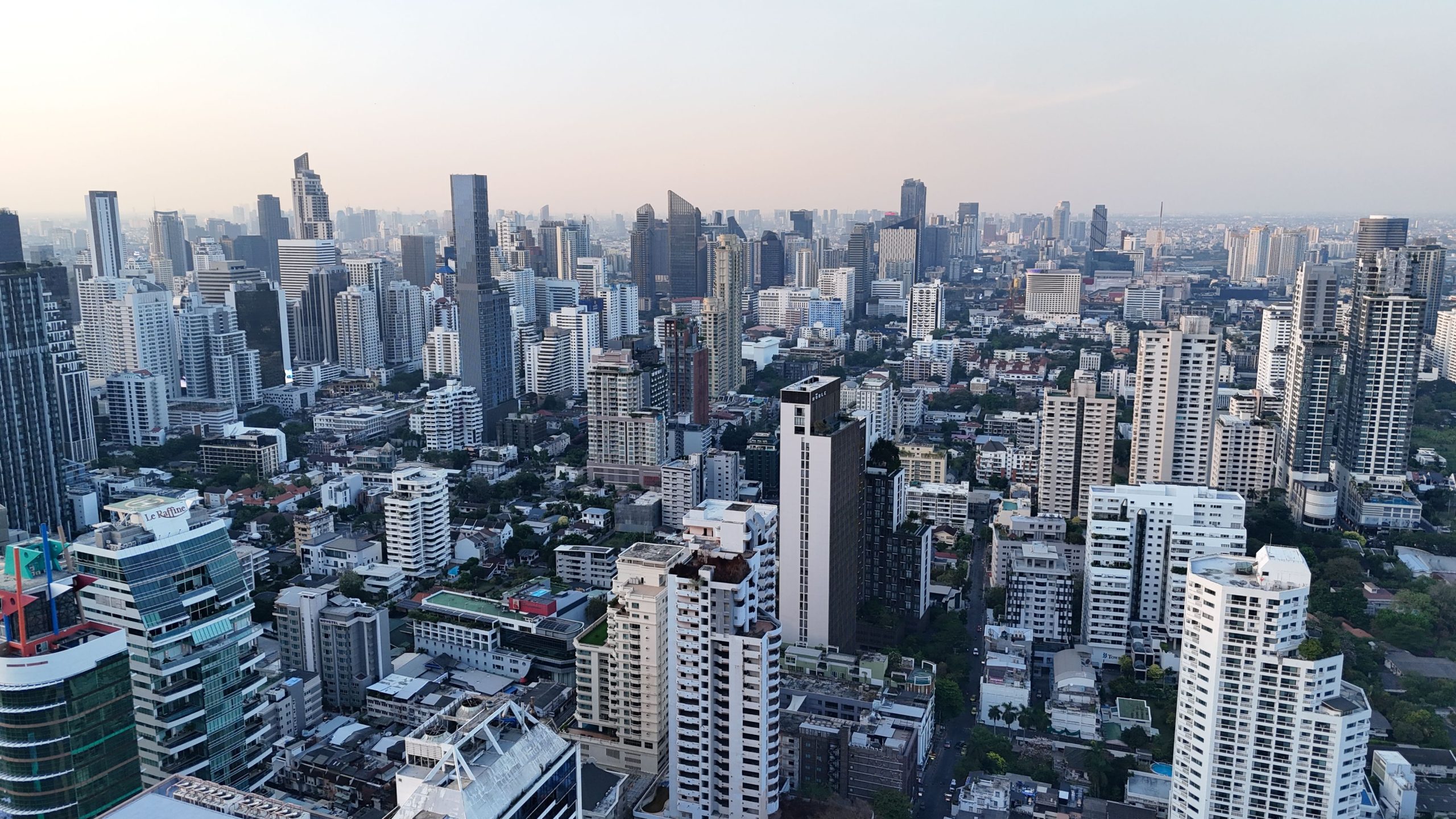
What would Bangkok be without any of this. Take it all away, the appliances, the cars, the trains, the airports, the hospitals, the weapons, the cameras, the smartphones, the social media, the internet itself, the global banking system, the international shipping that brings food and goods, the foreign tourists whose money funds twelve per cent of the GDP, and what is left. Pre-1960 Bangkok. Wooden houses. Klongs that have not been built over. Buffalo carts. A modest port. A monsoon-dependent agricultural economy. A country that the world would visit occasionally for its temples and otherwise leave alone. The Thailand the elite claims it would be fine without is a Thailand the same elite would not last a single afternoon in. The Anutin family does not get on a buffalo. The Chidchob family does not run construction empires without foreign procurement contracts. The CP Group does not become the country’s largest conglomerate without selling Western-style retail and Western-style processed food. The entire modern Thai elite is the product of selling foreign goods to Thai people while telling Thai people to be suspicious of foreign influence.
The Cake-And-Eat-It Hypocrisy
This is the cake-and-eat-it that I keep coming back to. The Thai establishment has accepted foreign influence at every level that makes its members rich, comfortable, and internationally mobile. It has accepted it in the form of consumer goods, infrastructure, education, medical care, military hardware, and capital. It rejects it only in the form of foreign opinion. Foreign products, yes. Foreign technology, yes. Foreign money, yes. Foreign tourists, yes, please, more of them. Foreign criticism, no, never, that is colonialism. The hypocrisy is mindbending and almost laughable if it was not so perverse.
How Thailand Threw The West Over For China
The part I always point to, and something every Western reader should also find truly two-faced, is this. The West gave Thailand the modern world. The institutions, the technology, the infrastructure design, the medical standards, the educational frameworks, the consumer economy, the international tourism brand. And the moment a new power offered Thailand a different kind of relationship, one with fewer questions about democracy and human rights and corruption, Thailand took it. The Belt and Road infrastructure deals with China. The high-speed rail to Kunming. The arms purchases from Beijing to replace American ones. The Chinese tour groups bussed in to replace the Western tourist base. The Chinese-owned condominium developments. The deportation of Uyghur refugees to please Beijing in February 2025. The studied Thai silence on the West Philippine Sea question. The careful balancing where Thailand takes everything the West offers and then somehow thinks it is acceptable to align itself with the power most willing to ignore everything the West asks for in return.
Two-faced is the polite word for it. Disgusting is closer to the truth.
What Western Governments Have Done About Any Of This
And while all of this has been happening, Western governments have done what exactly. Allowed it. Permitted it. Signed trade agreements that gave Thai exports preferential access to Western markets without demanding anything for their own citizens in return. Let their pensioners be humiliated at Thai immigration counters without lifting a finger diplomatically. Watched Thai marriage laws strip Western husbands of property and standing without intervening on behalf of their own nationals. Hosted the children of Thai elites in their universities while those same elites stood at podiums dismissing Western culture. Sold the F-16s and the Gripens and the MRI machines and the Volvos and the Boeings, taken the money, asked nothing in return for the dignity of their own people. Every Western government, British, American, German, French, Canadian, Australian, has stood by while its own citizens have been treated by Thailand as a category of foreigner to be managed, restricted, and lectured at, even as those citizens were the financial backbone of the relationship.
That is a failure of Western governments, not Thai cleverness. The people running Bangkok have noticed that nobody is going to defend the Westerners in Thailand from anything Thailand chooses to do to them, and have acted accordingly. The British retiree in Hua Hin is on his own. The American spouse in Pattaya is on his own. The German pensioner having visa problems is also on his own. Left for dead by a failure of what it meant to be Western.
The Thailand Apologists Are Buying Themselves Nothing
Now we come to the Thailand apologists.
The apologist is the Westerner who defends Thailand against every criticism. The one who says you should be grateful, you are a guest, you should keep your opinions to yourself. The lawyer who appears in countless YouTube interviews is one of them. The expat in the bar saying “well, this is their country” is another. The retired teacher writing forum posts about how foreigners need to stop complaining. The naturalised foreigner congratulating himself on having understood something the rest of you have not. None of them is buying themselves anything by doing this. The Thai establishment does not respect the apologist. The Thai establishment treats him exactly the same as the critic. He gets the same visa rules, the same TM30, the same arbitrary enforcement, the same bank account closure, the same lectures about cultural respect, the same conditional permission to remain. The difference between the apologist and the critic is not that one is protected and the other is not. The difference is that the critic understands what is happening to him and the apologist does not. The apologist is buying himself a longer queue before the same thing arrives at his door and nothing more.
The West Is Not Finished
The last thing this article wants to say, because it is important and it is true. The West is not finished. The West built the modern world. Every appliance in every Bangkok apartment, every train running under every Thai capital, every hospital scan that has saved a Thai life, every aircraft taking a Thai family on holiday, every weapon the Thai military used to try to steal Cambodian land, every piece of software running every Thai government system, came out of the labs and the design studios and the factories of the Western world. The West is going through a hard period. The institutions need repair. The political situation is messy. The cultural confidence has cracked. But the foundations of what made the West powerful are still there. The technologies are still being built in Western labs. The capital is still moving through Western banking systems. The cultural energy is still real, even if you have to look harder for it.
The countries that turned their backs on the West and threw in with cheaper, easier alternatives may discover, when the next decade plays out, that they bet on the wrong horse. China is not a substitute for the West. China is a transactional power that buys silence and asks for obedience in return. Thailand has chosen the relationship that asks no questions, and that means the answer to every Thai problem will be the answer Beijing finds convenient, not the answer that is good for Thailand.
The West Does Not Need Thailand. Thailand Needs The West.
The West does not need Thailand. Thailand needs the West and pretends not to. That asymmetry is the truth the Thai establishment cannot afford to admit. The foreigner who walks away from Thailand, takes his money, takes his expertise, takes his quiet contribution to the country, does no real damage to himself. He just goes somewhere else and does the same things there. The Thai establishment that loses him loses a piece of the structure it spent fifty years building.
Thailand without foreign influence is a Thailand without anything. The elite knows it. The apologists who defend the elite will eventually find out the hard way. And the foreigner reading this from outside, deciding whether to stay, whether to invest, whether to retire there, whether to send his money there, should understand that the country lecturing him about foreign influence is the country whose entire modern existence depends on the foreigner deciding to ignore the lecture and stay anyway.
That bluff has held for fifty years. It is not going to hold forever.
Frequently Asked Questions
Does Thailand really not need foreign influence?
The Thai establishment line that Thailand does not need foreign influence collapses the moment you look at what foreign influence actually means in the country. Air conditioning, refrigeration, modern transport, hospitals, military hardware, smartphones, social media, the internet itself, the global banking system, and the international tourism brand that funds twelve per cent of Thai GDP are all foreign in origin. Strip foreign influence out and Thailand reverts to pre-1960 Bangkok with wooden houses, klongs, buffalo carts, and a monsoon-dependent agricultural economy.
What does foreign influence actually mean in modern Thailand?
Modern Thailand depends on foreign influence at every level that makes the country function. Consumer goods invented in Europe, America, and Japan. Infrastructure designed using foreign engineering frameworks. Medical care that runs on Western pharmaceuticals and diagnostic equipment. Military hardware purchased from Britain, Germany, America, Belgium, and Austria. Banking systems built on Western financial architecture. Educational frameworks adopted from Western universities. The entire modern Thai elite has accumulated its wealth through selling foreign goods to Thai people while telling Thai people to be suspicious of foreign influence.
What kind of foreign influence does the Thai establishment actually reject?
The Thai establishment rejects only one specific kind of foreign influence, which is the kind that comes with criticism attached. Foreign products, foreign technology, foreign money, foreign tourists, foreign education for elite children, foreign medical care for elite families, foreign property in London and New York are all welcome. Foreign opinion, foreign accountability questions, foreign democracy commentary, foreign human rights criticism, foreign corruption oversight are all unwelcome. The line is consistent. Take the goods, refuse the questions.
Why has Thailand turned toward China?
Because China offers a relationship that asks no questions about democracy, human rights, corruption, or governance. The Belt and Road infrastructure deals, the high-speed rail to Kunming, Chinese arms purchases replacing American ones, Chinese tour groups replacing Western tourists, Chinese-owned condominium developments, the February 2025 deportation of Uyghur refugees to please Beijing, the studied Thai silence on the West Philippine Sea, all reflect a Thai elite calculation that the Chinese relationship gives them more freedom of action than the Western one. The cost is alignment with a transactional power that buys silence and asks for obedience in return.
Why are Western governments allowing this to happen?
Because they have made the calculation that defending their own citizens abroad is electorally invisible while domestic priorities deliver political reward. Western governments have signed trade agreements giving Thailand preferential access to Western markets without demanding anything in return for the treatment of Western citizens in Thailand. They have hosted the children of Thai elites in their universities while those same elites lectured Western culture from podiums. They have sold the military hardware, the medical equipment, the consumer goods, the aircraft, the cars, and asked for nothing in return for the dignity of their own nationals. That is a failure of Western governments, not Thai cleverness.
What should foreigners in Thailand actually do about this?
Understand what is happening, which is the first step. The Thai establishment does not respect the apologist any more than the critic. Both get the same visa rules, the same TM30 enforcement, the same bank account closure, the same conditional permission to remain. The difference is that the critic knows what is happening to him and the apologist does not. The foreigner who walks away from Thailand does no real damage to himself. He goes somewhere else and does the same things there. The Thai establishment that loses him loses a piece of the structure it spent fifty years building. That asymmetry is the truth the Thai establishment cannot afford to admit.
Sources
- Air conditioning — invented by Willis Haviland Carrier in Buffalo, New York, in 1902, the foundational invention for all modern climate control technology
https://www.britannica.com/biography/Willis-Carrier - Refrigeration — Carl von Linde, Germany, developed the first practical vapour-compression refrigeration system in 1876, the basis for every modern refrigerator
https://www.britannica.com/biography/Carl-von-Linde - Television — John Logie Baird demonstrated the first working television in London in 1925, alongside parallel American developments by Philo Farnsworth
https://www.britannica.com/biography/John-Logie-Baird - Microwave oven — invented by Percy Spencer at Raytheon in America in 1945, accidentally discovered while working on magnetron radar technology
https://www.britannica.com/biography/Percy-Spencer - Electric kettle — first patented in Britain in 1891 by the Crompton Company of Chelmsford
https://en.wikipedia.org/wiki/Electric_kettle - Incandescent light bulb and the LED — the incandescent bulb commercialised by Thomas Edison in America in 1879; the practical blue LED, enabling modern lighting, developed by Shuji Nakamura in Japan and recognised with the 2014 Nobel Prize in Physics
https://www.nobelprize.org/prizes/physics/2014/summary/ - Alternating current and mains electricity infrastructure — developed by Nikola Tesla in America and George Westinghouse, with parallel work by Thomas Edison, all in the late nineteenth century
https://www.britannica.com/biography/Nikola-Tesla - Flushing toilet — modern flushing water closet developed in Britain in the nineteenth century by figures including Thomas Crapper and George Jennings, foundational to all modern bathroom ceramics
https://en.wikipedia.org/wiki/History_of_plumbing - Modern shower — the enclosed mechanical shower patented in Britain by William Feetham in 1767, the basis for modern bathroom showers
https://en.wikipedia.org/wiki/Shower - Smartphone — the modern smartphone defined by Apple with the launch of the iPhone in America in 2007
https://www.britannica.com/technology/smartphone - Headphones — invented by Nathaniel Baldwin in Utah, America, in 1910, originally produced for the United States Navy
https://en.wikipedia.org/wiki/Headphones - Wi-Fi — the IEEE 802.11 wireless networking protocol developed by Australian and American engineers, with foundational patents from Australia’s CSIRO
https://www.csiro.au/en/about/challenges-missions/wifi - World Wide Web — invented by Sir Tim Berners-Lee at CERN in 1989, a British computer scientist whose protocols became the foundation of the global internet
https://www.w3.org/People/Berners-Lee/ - Social media — the dominant social platforms originated in America, with Facebook (2004), Twitter/X (2006), and Instagram (2010) all American inventions running on American infrastructure
https://www.britannica.com/topic/social-media - Automobile — Karl Benz patented the first true automobile, the Benz Patent-Motorwagen, in Mannheim, Germany, in 1885-1886
https://www.britannica.com/biography/Karl-Benz - Motorcycle — Gottlieb Daimler and Wilhelm Maybach built the first petrol-powered motorcycle, the Reitwagen, in Germany in 1885
https://www.britannica.com/biography/Gottlieb-Daimler - Traffic light — first three-position electric traffic light installed in Cleveland, Ohio, America, in 1914
https://en.wikipedia.org/wiki/Traffic_light - London Underground — the world’s first underground railway opened in London, Britain, in January 1863, the model for every metro system since including the Bangkok MRT
https://www.britannica.com/topic/London-Underground - Aeroplane — Orville and Wilbur Wright achieved the first powered, controlled, sustained heavier-than-air flight at Kitty Hawk, North Carolina, America, on 17 December 1903
https://www.britannica.com/biography/Wright-brothers - Jet engine — independently invented by Frank Whittle in Britain and Hans von Ohain in Germany during the 1930s, the foundational technology for all modern commercial aviation
https://www.britannica.com/biography/Frank-Whittle - Radar — developed by Sir Robert Watson-Watt in Britain in 1935, the technology underpinning every modern air traffic control system and security scanner
https://www.britannica.com/biography/Robert-Watson-Watt - X-ray — discovered by Wilhelm Conrad Röntgen in Germany in 1895, the foundational discovery for both medical imaging and modern security scanning
https://www.nobelprize.org/prizes/physics/1901/rontgen/biographical/ - MRI — magnetic resonance imaging developed in America and Britain through the 1970s by Raymond Damadian, Paul Lauterbur, and Sir Peter Mansfield, with Lauterbur and Mansfield receiving the 2003 Nobel Prize in Physiology or Medicine
https://www.nobelprize.org/prizes/medicine/2003/summary/ - CT scanner — invented by Sir Godfrey Hounsfield at EMI Laboratories in Britain in 1971, recognised with the 1979 Nobel Prize in Physiology or Medicine
https://www.nobelprize.org/prizes/medicine/1979/hounsfield/biographical/ - Penicillin and modern antibiotics — discovered by Sir Alexander Fleming at St Mary’s Hospital, London in 1928, with the Scottish microbiologist receiving the 1945 Nobel Prize in Physiology or Medicine
https://www.nobelprize.org/prizes/medicine/1945/fleming/biographical/ - Paracetamol — synthesised in Germany in 1878 by Harmon Northrop Morse and developed pharmacologically through German and American research
https://en.wikipedia.org/wiki/Paracetamol - Tank — invented in Britain during the First World War, with the first tanks deployed at the Battle of the Somme in September 1916
https://www.britannica.com/technology/tank-military-vehicle - Modern fighter jet — developed through British, German, and American military research during and immediately after the Second World War, with key contributions from Frank Whittle’s jet engine work in Britain
https://www.britannica.com/technology/jet-aircraft - Closed-circuit television — first operational CCTV system installed in Germany in 1942 by Siemens for V-2 rocket monitoring; commercial CCTV pioneered in Britain and America in the 1950s and 1960s, the foundation of all modern surveillance systems
https://en.wikipedia.org/wiki/Closed-circuit_television - Anutin Charnvirakul — Hofstra University engineering degree (1989), STECON construction fortune, three private aircraft, Swiss watch collection, demonstrating the complete dependence of the Thai elite on Western education, Western luxury goods, and Western capital
https://www.britannica.com/biography/Anutin-Charnvirakul - Thailand-China Belt and Road infrastructure — Thailand’s high-speed rail project connecting Bangkok to Kunming through a Belt and Road framework, signalling formal strategic alignment with Beijing on regional infrastructure
https://www.reuters.com/world/asia-pacific/thailand-china-high-speed-rail-belt-road - Thailand deports 109 Uyghurs to China — February 2025 forced return of Uyghur detainees to the People’s Republic of China despite credible international warnings of torture and arbitrary detention, in violation of Article 3 of the Convention Against Torture
https://www.hrw.org/news/2025/02/27/thailand-deports-uyghurs-china - Thai arms procurement from China — Thai Navy submarine and frigate orders from the People’s Republic of China replacing American suppliers, demonstrating the strategic pivot away from Western military partnerships
https://www.reuters.com/world/asia-pacific/thailand-china-arms-purchases - Tourism dependency — Thailand tourism accounts for approximately 12% of GDP and supports 6 to 8 million Thai jobs, the structural fact that makes the country’s hostility toward Western visitors economically incoherent
https://data.worldbank.org/indicator/ST.INT.RCPT.CD?locations=TH - Japanese ODA funded Thai expressways — the Japanese Overseas Cooperation Agency funded the bulk of Thailand’s expressway and rail infrastructure development through the 1980s and 1990s, foreign capital that built the country’s modern transport network
https://www.jica.go.jp/english/our_work/thematic_issues/transportation/thailand.html